




Showing posts with label Gothic. Show all posts

Thursday, January 09, 2014

Thornwood House by Anna Romer

When Audrey Kepler's former partner, and father of her daughter Bronwyn, dies suddenly she is very surprised to find that he has left her a property in Queensland called Thornwood House.  It is where Tony grew up, but he never spoke about his childhood years in the house and he most certainly never spoke of his family.

When Audrey and Bronwyn travel from the home in Melbourne, it is purely with the intention of seeing the house so that they would be able to decide to sell the house and then continue with their lives in Melbourne.

It doesn't take long before they both feel the attraction of living in a big rambling Queenslander style home, and the decision is made that rather than sell the house, they would make the move permanent.

Audrey, in particular, is drawn to the history of the house and to the history of Tony's family, which isn't a happy one. At the end of WWII, Tony's grandfather Samuel was accused of murdering his grandmother, Aylish. They had been young lovers, who had been torn apart by war, by circumstance, and seemingly by other people's interferences. Ostracised by the town, Samuel lived a pretty solitary life but Audrey come to believe that maybe he had been treated badly.

That was not the only unfortunate death to hit Thornwood and the family, and soon Audrey finds herself searching for the truth of all of them. But can she find the truth without putting her life, or the life of her daughter, at risk.

The story unwinds through three time frames. The first, and most prominent, is the current day storyline of a young woman trying to make a new life for herself and her daughter, both of whom are working through the grieving process.

The second storyline is that of Samuel and Aylish, the doomed lovers, which plays out against the spectre of World War II and it's immediate aftermath. This story is predominantly told through a series of letters.

The third story comes from the 1980s and focuses on the tragedies that caused Tony to leave his home in the first place, and why he would never speak of his early life. This particular storyline is told mainly through the pages of a journal but also through the memories held by the people that were left behind, who are slowly becoming friends with Audrey and Bronwyn.

 I felt that the author made interesting choices with her secondary characters. Just when you thought that a character was one thing, they would turn out to have a back story that completely changed the way that you thought of them.

I also enjoyed the relationship that developed with Danny, the local vet, who also happens to be deaf. I completely understood why Audrey struggled with the idea of moving on even though she had been by herself for so long. I will probably freak out the first time I am kissed again because it has been so long for me. I should put a disclaimer on that to say if it ever happens really!

My only minor qualm with the book was in relation to the bad guy. I can't really go too much into detail without sharing fairly big spoilers, but I did find myself wondering about the motivation, and the physicality and whether the latter in particular would be possible, or more precisely, likely.

Before I read the book, I had seen it compared to other Australian authors like Kate Morton and Kimberley Freeman, and the comparison is relevant. There is that same gothicky feel that is so common to Morton's books, although I would tend to say that this might be a bit darker than some of Kate Morton's books and definitely darker than Kimberley Freeman's books. There is the dual story line, the connection to the past through various artifacts and a kind of spiritual link to the past so if you like any or all of those factors then this could be a book for you.. 

Where Romer really stands out is in her ability to describe the landscape without overwhelming the reader. For example, there is a section where one character is explaining carnivorous plants to  Bronwyn, and I found myself thinking that it shouldn't have been anywhere near as fascinating as it was!

This was an excellent debut novel and I will be looking forward to reading Anna Romer's next book with great interest.

Rating 4.5/5 

Synopsis


When Audrey Kepler inherits an abandoned homestead in rural Queensland, she jumps at the chance to escape her loveless existence in the city and make a fresh start. 

In a dusty back room of the old house, she discovers the crumbling photo of a handsome World War Two medic - Samuel Riordan, the homestead's former occupant - and soon finds herself becoming obsessed with him. 

But as Audrey digs deeper into Samuel's story, she discovers he was accused of bashing to death a young woman on his return from the war in 1946. When she learns about other unexplained deaths in recent years - one of them a young woman with injuries echoing those of the first victim - she begins to suspect that the killer is still very much alive. 

And now Audrey, thanks to her need to uncover the past, has provided him with good reason to want to kill again


Monday, October 24, 2011

The Lantern Readalong Part 3

This is the third, and final, part of The Lantern readalong which is being hosted by Carl from Stainless Steel Droppings as part of RIP VI. You can read parts 1 and 2 by clicking on the links below:

Part 1
Part 2

1. Now that it's all said and done; what did you think of the book? Did you see the ending coming?

I liked the book, but didn't love it as much as I hoped to. I kind of thought the end fizzled a little bit. The ties that bound the two stories together, other than the house itself, were a little loose for my liking.

I am not sure what I think about the ending of Benedicte's story. There does seem to be a certain irony in the fact that she was losing her sight, but felt that the condition that she was diagnosed with was too convenient an explanation for the visions that she was having. I was both surprised and not surprised when we found out about her guilty secret that she carried around with her for all those years.

I do really love the idea of gothic novels, especially a modern gothic, and this book is a good example of this style of storytelling.

2. What do you think of the characters? Lawrenson took us on a twisty little ride there, I had trouble deciding who was good and who wasn't for a while there! What do you think of Dom? Of Sabine? Rachel?

I am going to start with the character that I struggled with the most in terms of characterisation and that is Rachel. I was reading the section of the book where we find out exactly what happened and for a little while there was appalled that she was going to be blamed for what happened to her. That isn't what ended up happening at all, but it sure felt like that was what was coming.

As for Dom, I am still undecided about how I feel about him days after I finished the book.We found out why he was so secretive about what happened with Rachel, why he was reluctant to talk to Eve at all but I actually don't feel like we got to know him as a person very much at all, other than the fact that he was rich and musical.

Sabine was quite the piece of work in the end wasn't she. I found her manipulative especially of Eve and to a lesser extent to Rachel, using both of them to try and further her own cause. I was kind of surprised when Eve suggested that they might end up being friends.

Finally...Eve. There were certain parts of the book where I wanted to shout at Eve, particularly  as she accepted the treatment that she was receiving from Dom, including being isolated from her support network etc,  being led around by Sabine etc. I was so pleased when she finally confronted him and showed some gumption, but then she undid that by starting to keep her own secrets too.

3. Pierre was such a conflicted character. In the end, do you think he killed Marthe and Annette, or did the fall to their deaths because of their blindness?

I was disappointed in the one dimensional portrayal of him. I know we had a motivation for why he was as he was once he was older but there didn't seem to be any nuances when it came to him. I guess that there are some people who are nasty kids who grow up into nasty adults, but in some ways he would been a much scarier character if you actually didn't know which Pierre you were getting. Maybe that is what the author was trying to achieve by saying that Marthe hadn't or couldn't see this aspect of Pierre's personality?

I definitely think he killed Annette, and most likely Marthe too, although I am thinking that perhaps Marthe's death was more accidental given her blindness and the empty pool. Maybe she fell, maybe she didn't. At the end of the day I would count Pierre as being accountable for both deaths.

4. The book is being compared to Rebecca and Daphne du Maurier's writing. Do you think the book lives up to that description?

In my experience as soon as those kinds of labels are placed on an authors, there is an almost inevitable raising of expectations on the part of readers and almost as inevitably people may be disappointed. Let's put it this way, I don't think that in fifty years time someone will be saying that a new book is like The Lantern.

That kind of sounds as though I didn't enjoy the book which isn't really the case. There were things that the author did really well - for example, the details which made the book a delight for the senses. The smells, the sights, the taste - all came to life through the words on the page and I would quite happily have read those passages over and over.

I mentioned in a previous post that I think that I would have enjoyed this book so much more if I had of just kept reading and not actually stopped to think about the characters and the plot. It was very readable, and I could quite easily imagine myself there in the Provence countryside.

5. Did you have any problems with the book? Narration? Plot? The back and forth between two different characters and times?

Sometimes it was a little unclear which story we were reading in each new chapters, especially seeing as some times the narrative swapped in every chapter but then there would be several chapters of one narrator.

6. Do you think Lawrenson tied both stories together well in the end? Is there anything she could/should have done differently?

I don't know about could/should have done differently because, after all, this is the author's creative work and so she brings to bear all of her life experiences, all of her agendas and more to create her work.

The house was more than adequate to tie the two stories together but I am not sure about the other symbols such as the lantern itself, and also the other murders that it was inferred were connected to the characters in the book.

I was just struck by the thought that houses bear witness to so much (if an inanimate object can be said to witness anything). Think how many people a house might have living in it over an extended period of time. The joy, the sadness, the laughter and the tears, especially if it is a house like the one in the book that has been home to generations of people over hundreds of years!

I was wondering about Benedicte was going to fit into the modern storyline and thought that the way that particular aim was achieved was actually quite clever in terms of the way she got to tell her story and explained a lot about how the older storyline was being told through out the earlier parts of the story.


7. One problem I had with the novel is the reliability of the narrators. Do you think any of them were telling the truth? Which ones?

Ah, unreliable narrators. Where would this kind of storytelling be without them? It's a bit like all the foreshadowing comments. Both were in place to act as hooks to keep you hoping that you would find out exactly what is going on...eventually.

I think this quote summarised this quite well. Often, as readers, we like things to be linear, to be neat and tidy, but sometimes they just aren't!

All of which goes to show how dangerous it is to assume connections where there are none, to link events that have no link, to want tidy storytelling when real life is not like that, to draw too much on the imagination when it is so often misleading. (Page 381)

I wanted to say a special thanks to Carl for hosting this readalong, and to Kailana and Heather who contributed questions and to Netgalley for provided me with an E-Arc. I started reading that, but ended up also getting the book from the library once I knew that I had to spread the reading out for readalong purposes!.

A modern gothic novel of love, secrets, and murder—set against the lush backdrop of Provence


Meeting Dom was the most incredible thing that had ever happened to me. When Eve falls for the secretive, charming Dom in Switzerland, their whirlwind relationship leads them to Les GenÉvriers, an abandoned house set among the fragrant lavender fields of the South of France. Each enchanting day delivers happy discoveries: hidden chambers, secret vaults, a beautiful wrought-iron lantern. Deeply in love and surrounded by music, books, and the heady summer scents of the French countryside, Eve has never felt more alive.


But with autumn’s arrival the days begin to cool, and so, too, does Dom. Though Eve knows he bears the emotional scars of a failed marriage—one he refuses to talk about—his silence arouses suspicion and uncertainty. The more reticent Dom is to explain, the more Eve becomes obsessed with finding answers—and with unraveling the mystery of his absent, beautiful ex-wife, Rachel.

Like its owner, Les Genevriers is also changing. Bright, warm rooms have turned cold and uninviting; shadows now fall unexpectedly; and Eve senses a presence moving through the garden. Is it a ghost from the past or a manifestation of her current troubles with Dom? Can she trust Dom, or could her life be in danger?


Eve does not know that Les Genevriers has been haunted before. Benedicte Lincel, the house’s former owner, thrived as a young girl within the rich elements of the landscape: the violets hidden in the woodland, the warm wind through the almond trees. She knew the bitter taste of heartbreak and tragedy—long-buried family secrets and evil deeds that, once unearthed, will hold shocking and unexpected consequences for Eve.

Friday, October 21, 2011

The Lantern Readalong Part 2

After only posting my thoughts on part 1 of this book yesterday, I have continued reading and now have composed my thoughts on the second part.  Please bear in mind that this post is about the middle of the book and there are therefore SPOILERS ahead!

1. The title of this book is The Lantern, and a lantern makes an appearance in both of the stories. In Benedicte’s past, it had a meaning, but what do you think the lantern signifies in her future and in Eve’s story?

Oh  dear! A hard question to start with.

Actually, I think that there are two roles that the lantern is fulfilling. The first is a mechanism for tying the two stories together and maybe it is a symbol for both Benedict and Eve of shining a light on the past.

For Benedicte it is a sign of love with Andre, but also for her in later life it seems to also be symbolic of revealing exactly what went on!

2. Carl mentioned scents in last weeks questions, but they have been addressed even more in these sections. What significance do you think scents have in this story overall?

As I was reading this section I was very much reminded of a book I read earlier this year called The Various Flavours of Coffee by Anthony Capella. In that case the main character has a strongly defined sense of taste which he uses to identify all the different notes of various coffee beans! In this section Marthe is divining scents for perfume rather than coffee but the sense of appreciation was paralleled.

I find the idea that some people have better noses than other people to be totally fascinating and enjoyed reading the parts about Marthe.

Marthe's career as a perfumer has also reminded me of the visit I made to a French perfume factory many years ago.

3. What do you think of the combining storyline of Marthe? She connects Benedicte, Eve, and Rachel. What do you think will be revealed about this connection in the next sections?

Like I just mentioned I am enjoying reading Marthe's story. I am not sure that I feel that the connection between the other four characters is really strong enough, but it is moving the story forward which is the purpose I guess.

4. Now that things are beginning to move along, what do you think of the characters? Are any standing out for you? Do you particularly like any? Dislike any?

I am going to start with a secondary character - can I just say I don't really like Sabine. It is like she is a puppeteer manipulating the events that are happening and the actions of Eve in particular.

I am hard pressed to choose a character that I really, really like! Benedicte is okay as is Marthe, but I find Eve to be far too accepting and passive, particularly in respect of her relationship with Dom and his refusal to talk about anything. As for Dom, I don't distrust him quite as much as I did, but I think that he really needs to answer some questions and start actually communicating with this woman that he professes to love!

I said in my previous post that I found Philippe to be a one dimensional character and I don't think we have seen anything to find out why he was the way he was and to give him any depth. The reader is not meant to like him or to empathise with him in any way shape or form, and I don't so that appears to be right then!

Provence is synonymous with sunflowers and now  lavender to me
5. What do you think really happened to Marthe and Annette? What do you think the significance of the bones in the pool are to the story? Especially now that it has been revealed that Rachel is also dead.

I think Marthe and Annette are dead and that Pierre killed them. The bones in the pool are there to move both aspects of the story ahead and also to cast more doubt on Dom and what exactly happened to Rachel. I must confess that at one point I did wonder if perhaps Rachel had died of natural causes and Dom had chosen to bury her and so came back to the house so that he could be close to her even in death but I am changing my mind about that theory at the moment.

6. Do you have any other things you think are significant to talk about? Are there any other predictions to be made for the last two sections of the book?

No predictions, I just want to keep reading because even though I am still finding holes in terms of characterisations and plot I am still finding the book immensely readable.

7. Lastly, what do you think of this book overall? Other than for the read-along, why are you reading it? Is it meeting your expectations?

I would have read the book eventually as I do enjoy a good gothic type read and also have had an obsession with all things French over the past few months so this ticks boxes for me!

And now I am all caught up on the posts and can post about the final section of the book on Monday, and now that I have posted about this section I can go and finish reading it! Seems like a good way to spend a rainy Friday night!

Thursday, October 20, 2011

The Lantern Readalong Part 1

I'm late! I'm late! I'm late!

So, yeah! It may be 10 days late, but here are my thoughts on the first part of the readalong of The Lantern which is being hosted by Carl at Stainless Steel Droppings as part of RIP VI.

I haven't had time to read the book before now but today I had a space in my schedule so I picked this up and have been sucked right into the world! More than anything I want to share my thoughts for my own records!

1. This may seem like an obvious opening question, but what do you think of The Lantern thus far?

I feel bad that I am so far behind because what I have read of the book is quite good. I do wonder if it is trying too hard to be …. gothic …. for want of a better description though.

2. The book appears to be following the experiences of two different women, alternating back and forth between their stories. Are you more fond of our main protagonist's story or of Benedicte's or are you enjoying them both equally?

I think I am enjoying the modern storyline more than the past, which is something that I find quite interesting because whenever I read these kinds of books I tend to like the historical story a lot more! Maybe part of the reason for that is that in my usual reads of this nature the two strands tend to be a bit further apart than they are in this book and therefore the two eras aren’t distinct enough in my mind.

3. The Lantern is a book filled with descriptions of scents. How are you liking (or disliking) that aspect of the book? How do you feel about the lavish description of scents? How are the short chapters working for you?

I would definitely describe as a sensual read. The author takes great pains to describe the smell, taste, sight and feel of various events. There were lots of passages where I literally stopped just to appreciate the description or to imagine the smell or taste or sights.

Here is an example of a passage that I read a number of times as it really caught my attention from page 60:

We shared a capacity to stay very still and just look, and touch, and smell. Toward the end of summer, we would lie facedown in the courtyard. After the brief, hard rainstorms of late August, the earth was caramel-sweet and spicy, and the warm, smitten flesh of fruit gave off a smoke of incense. I may be imagining this of course. Perhaps memory has rendered these interludes larger-than-life, but it's true we did spend hours simply looking and inhaling, feeling life slowly in close-up, burrowing into our surroundings, eating vanilla pastries with dirt on our fingers.

Marthe loved to talk about the scents and smells of the farm. My sixth sense was never as acute as hers (as I said earlier, my imagination has always been poor, which leads me to worry that the present situation is indeed precisely as I fear) but I could almost always smell what she smelled. Perhaps there was a family nose we both inherited that enabled us to read aromas, some small quirk of nasal membrane or nerve setting that provided an extra sensitivity.

4. How would you describe the atmosphere of Parts 1 and 2 of The Lantern?

Brooding, foreboding. Definitely oh-my-goodness something bad has either happened or is going to happen soon!

5. Has anything surprised you to this point? Anything stand out?

To be honest, I am a little bit surprised at some of the reactions I am having after I stop to think about the book. I am totally engrossed in it as I am reading it, even though I know that I am being led along by the foreshadowing and the hooks that are embedded in the end of a lot of the chapters, designed specifically to keep you reading. When I stop and think about it, I am not as hooked as I thought I was!

As an example of a keep-you-reading hook, I was surprised by Marthe's proclamation in the last of Benedicte's chapters in this section. Marthe is Benedicte's sister.

6. What are your feelings about Dom in these first two sections of the story?

I think we are deliberately being lead to believe that Dom has huge secrets and with the foreshadowing that is being used expected to think the worst of Dom. To be honest though, I think I will be a bit disappointed if the secrets are so obvious as we are being led to believe as there might be a lack of subtlety if that is the case.

In a way, the characters that we are supposed to not like (Dom and Philippe) actually feel a bit cliched to me.

Bonus question: Did anyone else hear "Last night I dreamt I went to Manderley again" ringing in their ears through the first sections of the book?

To me it seems that the author is making a conscious effort to evoke the book Rebecca, to the point of the protagonist that we don’t know the real name of, the use of one of du Maurier’s heroine’s name as the name of the ex wife, especially in the use of isolation – the husband who on the one hand is all encompassing but on the other is emotionally isolated whenever the subject of his ex wife comes up, the way they are pretty isolated as a couple with few visitors, the locale of the house being isolated from the village.


I also wanted to mention that I am a sucker for a story within a story and so loved the use of the fairy tale and also the article as part of the narrative!

I have now finished part 3 and will try to read part 4 tomorrow so that I can be all caught up in time for the end of the readalong! Maybe anyway!

Tuesday, October 04, 2011

Teaser Tuesday: Nine Coaches Waiting by Mary Stewart

Mary Stewart has been a great influence on a number of authors I like to read and so I thought it was about time that I found out for myself what the fuss is all about!

This book was suggested as a great place to start and also as being suitably gothic enough to qualify as a read for the RIP IV challenge.

My teaser comes from page 108. It is actually a bit further on in the book from where I am up to so I haven't actually met Raoul myself, but I have heard from other Stewart fans that he is quite the man. I hope so. 

It was to have been expected. It would be a very odd Cinderella indeed who can be thrown out of such dreary seclusion as the orphanage had offered me, into contact with Raoul de Valmy, without something of the sort happening. A man whose looks and charm were practically guaranteed to get him home without his even trying, had exerted himself to give a very lonely young woman a pleasant evening. An evening to remember.

Teaser Tuesday is hosted by Miz B at Should Be Reading. Head on over to find out all about it, and how to join in!

Wednesday, September 27, 2006

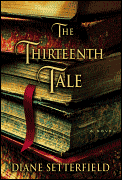
The Thirteenth Tale by Diane Setterfield

A compelling emotional mystery in the timeless vein of Daphne du Maurier's Rebecca, about family secrets and the magic of books and storytelling.

Margaret Lea works in her father's antiquarian bookshop where her fascination for the biographies of the long-dead has led her to write them herself. She gets a letter from one of the most famous authors of the day, the mysterious Vida Winter, whose popularity as a writer has been in no way diminished by her reclusiveness. Until now, Vida has toyed with journalists who interview her, creating outlandish life histories for herself - all of them invention. Now she is old and ailing, and at last she wants to tell the truth about her extraordinary life. Her letter to Margaret is a summons.

Somewhat anxiously, the equally reclusive Margaret travels to Yorkshire to meet her subject - and Vida starts to recount her tale. It is one of gothic strangeness featuring the March family; the fascinating, devious and wilful Isabelle and the feral twins Adeline and Emmeline.

Margaret is captivated by the power of Vida's storytelling. But as a biographer she deals in fact not fiction, and she doesn't entirely trust Vida's account. She goes to check up on the family, visiting their old home and piecing together their story in her own way. What she discovers on her journey to the truth is for Margaret a chilling and transforming experience.


I first saw a post about this book over on Heather's Blog, and as soon as I saw it, I added it to my list and requested it from the library!

There is a lot of hype around this book around the place, with even Barnes and Noble making it their first ever "Barnes and Noble Recommends" book. The danger of books with this much hype is that the book will not live up to it - fortunately this one does, both for me and just about everyone else who has read it. I think I am yet to see a review from someone saying that they really didn't like it.

The overriding story is a simple one - a reclusive author decides to finally tell the truth about her life. In the past when Vida Winter had been interviewed she had given a variety of different answers, but now it is time to reveal her story. It is the undercurrents lying beneath this simple story that make this book compelling - the mysterious events at Angelfield, the strange and compelling relationship between the twins Emmaline and Adeline, the life and in some cases deaths of those who are charged with taking care of them, and the relationship of all of these people and events to the life of Vida Winter.

Also threading through the story is Margaret's search for the truth about her own birth and relationships with her parents, especially her mother who has been withdrawn for as long as she can remember.

The author does an amazing job at creating an atmosphere where trying to find the truth is bound to uncover many surprises and maybe some unwanted secrets.

Populated with a cast of lonely characters searching for their own truths, this book is an amazing read, and well worth picking up!

Rating 5/5


Other Blogger's Thoughts:

Mog's Book Blog
A Striped Armchair
Chris @ Book-a-rama
Maw Books
Some Reads
Melody's Reading Corner
Things Mean a Lot
Bold. Blue. Adventure
Books and Other Thoughts
TEMPLATE CREATED BY PRETTYWILDTHINGS