Showing posts with label Irene Nemirovsky. Show all posts

Wednesday, November 19, 2008

Le Bal by Irene Nemirovsky


Two classic tales from the author of Suite Francaise brought together for the first time in one volume.

Le Bal is a sharp, brittle story of a girl who sets out to ruin the mother she hates. The Kampfs have risen swiftly up the ranks of 1930s Parisian society. Painfully aware of her working class roots, and desperate to win acceptance, Madame Kampf decides to throw a huge ball to announce her arrival to society. Her daughter Antoinette, who has just turned fourteen dreams of attending, but Madame Kampf is resolved not to present her daughter to potential admirers. In a fury of adolescent rage and despair Antoinette exacts a swift and horrible revenge...
These two novella's are both short, at around 60 pages each. The synopsis is quite good for this novella, so I won't worry too much about recapping. What I would say is that there are times when reading Nemirovsky's work that you have to wonder if everyone she knew was unlikeable. It is not the first of her books that have had me wondering this - the characters in David Golder were the same.

The family dynamics were difficult to say the least, with a distant father, a mean spirited, social climbing mother, and the daughter was definitely in need of some discipline!

As a commentary on the difficulty for an outsider to break into the all important society it was effective.

Given that the story is so short, it must have been an effective exercise given how much I felt about each of the unfortunate characters in this very unhappy little world!
Snow in Autumn pays homage to Nemirovsky's beloved Chekhov and chronicles the life of a devoted servant following her masters as they flee Revolutionary Moscow and emigrate to a life of hardship in Paris. As the crisis pushes the family to the brink of dissolution, Tatiana struggles to adapt to life in Paris and waits in vain for her cherished first snows of autumn.

After the self absorbedness (not even a word I am sure!) of the characters in the first novella, it was a breath of fresh air to find more heart within this one! Whilst I am not all that familiar with Chekhov and therefore did not catch the homage to him, it was easier to like the Carine family as they flee from the Bolshevik revolution, accompanied by their faithful servant Tatiana and the ghosts of the past.

The portrayal of the difficulty of coping with such massive changes was movingly portrayed, particularly through the eyes of the elderly Tatiana as she waits for the first signs of snow and winter in a strange new city.

Nemirovsky touched not only on the physical change of location for the family, but also on the moral changes that occurred as a family used to the best of everything have to get used to living on not very much at all.

It was this novella which redeemed this little book for me. If I had only had Le Bal to base my thoughts on I would have been a little disappointed.

Saturday, November 03, 2007

Fire in the Blood by Irene Nemirovsky


Here is a missing piece of the remarkable posthumous legacy of Irene Nemirovsky, author of the internationally acclaimed Suite Francaise.

Written in 1941, the manuscript of Fire in the Blood was entrusted in pieces to family and a friend when the author was sent to her death at Auschwitz. The novel - only now assembled in its entirety - teems with the intertwined lives of an insular French village in the years before the war, when "peace" was less important as a political state than as a coveted personal condition: the untroubled pinnacle of happiness.

At the centre of the tale is Silvio: in his younger years he fled the boredom of the village and made a life of travel and adventure. Now he's returned, living in a farmer's hovel in the middle of the woods, and, much to his family's chagrin, perfectly content with his solitude.

But when he attends the wedding of his favourite young cousin - "she has the thing that, when I was young, I used to value most in women: she has fire" - Silvio begins to be drawn back into the complicated life of this small town. As his narration unfolds, we are given an intimate picture of the loves and infidelities, the scandals, the youthful ardor and regrets of age that tie Silvio to the long-guarded secrets of the past.

Nemirovsky wrote with a crystalline understanding of the pretensions and protection of society, and of the varied workings of the human heart, in language as evocative of a vanished era as of the emotional and moral ambiguities in her characters' lives. All of which was evident in Suite Francaise - and abundantly evident again in this powerful, passionate novel.
Life in a small town has long been a favourite topic amongst novelists, and this is Irene Nemirovsky's take on the secrets within a small town in rural France, and within a family.

The main narrator is Silvio. As a young man he had felt restricted by life in his small home town and had spent many years travelling. Now, he lives in a farmer's hovel outside town, and like his home he is pretty much an outsider, and he's happy like that!

After attending the wedding of his cousin's daughter, Silvio is gradually drawn back into the life of the town as secrets of infidelity, murder and deceit are slowly revealed through the narrative. Unfortunately, some of these secrets are Silvio's secrets as well, and it becomes apparent that not everyone in the book is who they have appeared to be through the years.

The characters in this book, although flawed, are much more likable than the main character in David Golder, which was her first book to be published, and the way that the secrets are unveiled was really clever.

The only thing that didn't work for me was the ending, because it really didn't feel like an ending. It seemed to me that the book needed maybe one more chapter, just to wrap things up, but that is a totally personal thing, so might not be a problem for other people who read this book. Maybe the book wasn't really finished when Nemirovsky died. The notes in the book tell us that part of this book was found in the suitcase that held Suite Francaise, and other parts of it were sent to friends. It was only recently that the two parts of the story were put together, and this book was born.

For a really short book (only 130 pages of story), the story was interesting and the book overall enjoyable, and easy to read in one sitting.

Rating 4/5

Other Blogger's Thoughts:

The Magic Lasso

Tuesday, October 02, 2007

David Golder by Irene Nemirovsky


In 1929, 26-year-old Irène Némirovsky shot to fame in France with the publication of her first novel David Golder. At the time, only the most prescient would have predicted the events that led to her extraordinary final novel Suite Française and her death at Auschwitz. Yet the clues are there in this astonishingly mature story of an elderly Jewish businessman who has sold his soul.

Golder is a superb creation. Born into poverty on the Black Sea, he has clawed his way to fabulous wealth by speculating on gold and oil. When the novel opens, he is at work in his magnificent Parisian apartment while his wife and beloved daughter, Joy, spend his money at their villa in Biarritz. But Golder’s security is fragile. For years he has defended his business interests from cut-throat competitors. Now his health is beginning to show the strain. As his body betrays him, so too do his wife and child, leaving him to decide which to pursue: revenge or altruism?

Available for the first time since 1930, David Golder is a page-turningly chilling and brilliant portrait of the frenzied capitalism of the 1920s and a universal parable about the mirage of wealth.

Like most other readers out there, I first heard of Irene Nemirovsky when Suite Francaise was published. Now it seems that the publishers are cashing in on the popularity of that book, er....I mean taking the opportunity to let us become acquainted with some of the author's earlier books that originally propelled her to fame in France in the late 1920s and 1930s.

David Golder is a self made man. He started out living in a small town on the Black Sea, dirt poor, but determined to make something of himself, regardless of how many people he must trample on his way to top. And he has. He is now one of richest men in Paris, married to a beautiful socialite wife, with a beautiful socialite daughter. He is however unhappy, and when things start to go wrong with his health, and he is no longer unable to wheel and deal, the money runs out, and it is suddenly clear to Golder just how alone he really is. Even his wife and daughter desert him to a degree. When he needs to make just one more deal, his life comes full circle as he once again finds himself in that same small town on the Black Sea.

A lot of the characters in this book are not particularly likable, but Nemirovsky does give them shades of unlikeability and a certain depth that keeps you interested and reading. It also doesn't hurt that the book is quite short meaning that it is a somewhat concise study of a man who appears to have everything, but may well in fact have nothing worth having!

The version I read was beautifully presented as a small hardcover book, and it even had one of those ribbons that you can use to mark your page that you don't often see any more . It was such a pleasant surprise when I realised that it was there, and despite the fact that it is a really small thing about the quality of the presentation, it did enhance my enjoyment of this book! Yes....I know....small things and all that!

Having now read two of her books, it seems to me that the authors personal story remains more compelling than her books, even though her books are definitely readable. I was interested to read somewhere the other day that they have discovered another unpublished work by this author called The Fire in the Blood, and that it is going to be published shortly. It goes almost without saying that I have my name down on the request list!

Rating 4/5

Saturday, August 05, 2006

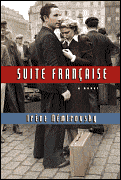
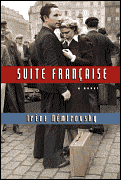
Suite Francaise by Irene Nemirovsky


In 1941, Irene Nemirovsky sat down to write a book that would convey the magnitude of what she was living through, not in terms of battles and politicians, but by evoking the domestic lives and personal trials of the ordinary citizens of France. She did not live to see her ambition fulfilled, or to know that sixty-five years later, Suite Francaise would be published for the first time, and hailed as a masterpiece.

Set during a year that begins with France's fall to the Nazis in June 1940 and ends with Germany turning its attention to Russia, Suite Francaise falls into two parts. The first is a brilliant depiction of a group of Parisians as they flee the Nazi invasion and make their way through the chaos of France; the second follows the inhabitants of a small rural community under occupation who find themselves thrown together in ways they never expected. Nemirovsky's brilliance as a writer lay in her portrayal of people, and this is a novel that teems with wonderful characters, each more vivid than the next. Haughty aristocrats, bourgeois bankers and snobbish aesthetes rub shoulders with uncouth workers and bolshy farmers. Women variously resist or succumb to the charms of German soldiers. However, amidst the mess of defeat, and all the hypocrisy and compromise, there is hope. True nobility and love exist, but often in surprising places.

Irene Nemirovsky conceived of Suite Francaise as a four- or five-part novel. It was to be a symphony - her War and Peace. Although, only two sections were finished before her tragic death, they form a book that is beautifully complete in itself, and awe-inspiring in its understanding of humanity.

This was a very good read. The two sections that are included in this novel are called Storm in June and Dolce. The first part focuses on the experience of those people who fled Paris in front of the German occupation of France. Many of the people who fled were killed as the roads and railways they were using to escape were bombed, and Nemirovsky's words evoke the panic and the desperation of the people as they search for food and accommodation. During this first part we are introduced to several distinct characters, or groups of characters, providing a framework for a sharp commentary on the social classes of the time, from the very rich and powerful, to the bourgeois artists, middles classes and the poor. At first it seems like there is no connection at all between all these different groups but as the novel progresses, especially into the second section you see how gradually the author ties the characters together. Many of the survivors of this exodus ended up back in Paris after harrowing experiences.

The second part of the novel focuses on a small town that has been occupied by the Germans, and how the townspeople cope with that. At first there is a frosty wall built against the Germans, but gradually they become part of the town, with some of the women falling in love with German soldiers, with bottles of wine shared around the meal table, until it is time for the garrison of troops to move out to a new theatre of war. One of the German officers is a particularly well written character - giving a very human face where it would be so easy to portray a villainous, cold and uncaring conqueror.

The book is incredibly descriptive, and at times the story drags a little bit because of it, but what is conveyed through the words and pages is the immediacy of the situation. This is not some scene imagined from the newsreels. These kind of situations were what the author was actually living, which makes it all the more poignant to read about her characters and their experiences. Many of the characters are flawed, particularly the artists and the upper classes. In some ways, the story almost feels like a study of the priorities in our lives. When the characters are fleeing Paris, what are the things that are valued amongst all others - a collection of china, manuscripts, linen, the family silverware, and yet by the end of the journey for some of the characters there will be a reassessing of those priorities. For others though, there is not, although it has to be said that looking through the appendices it seemed that their changes may have been intended to be more long term.

In some ways these two parts of the book do feel complete, but there are others where it was obvious that there was more to come. There was at least one character that was introduced that there was no further development with, and there were events that were left unresolved, but for the most part it doesn't really affect the enjoyment of the book.

For all that is said about the book though, it may be that the story OF the book is as interesting, and maybe even more interesting, than the story IN the book. Irene Nemirovsky was a successful author of Russian Jewish descent, who moved to France during the Russian Revolution, with her family losing all their fortune. In 1939, she and her family converted to Catholicism in the hope that this would protect them. She started this book in 1941, and published as an appendix to the book are the notes that she had written which give some idea of the direction that she wanted to take and her thoughts during this time. Before she could complete the four or five parts to the book, she was arrested, taken to Auschwitz and never heard from again.

In some ways, the second appendix is even more poignant. It features a series of correspondence between the author and some of her friends and colleagues, in the time leading up to the Occupation, showing her fears for her own wellbeing, and that of her family. The tone of the letters change after her arrest, as her husband and friends try to find out where she has gone, to intercede on her behalf. At one point her husband even offers to trade himself for her, not realising that at time she was already dead.

Her children only just managed to escape the authorities several times, not realising that amongst their luggage was the manuscript for this book. It was only after many years that her daughters could bring themselves to read it, so this book that was first written in 1941 was only just published in France in 2004.

For me, this was a very poignant read, and well worth taking the time and making an effort to read, even though at times it felt overly descriptive.

Rating 4/5


Other Book Blogger's thoughts:

You Can Never Have Too Many Books
One More Chapter
The Inside Cover

TEMPLATE CREATED BY PRETTYWILDTHINGS