




Showing posts with label Pulitzer Prize. Show all posts

Sunday, January 13, 2008

Biting the Bullet


This post has been sitting in draft for several months now, but I am finally going to bite the bullet and join in on The Pulitzer Project challenge. The main reason for joining is the fact that there is no deadline, so it fits in with my library deadlines a lot easier than many of the other challenges do.

The following list is all the prize winners (all 81 of them!). I have read ten, but a few of them were years ago, so a reread wouldn't hurt! There are only a couple that I have previously reviewed but I have put links on in those two. The ones I have read are marked in red.


2007 - The Road (McCarthy)
2006 - March (Brooks) - Read this about 3 years ago
2005 - Gilead (Robinson)
2004 - The Known World (Jones)
2003 - Middlesex (Eugenides) - listened to this in my pre-blogging days
2002 - Empire Falls (Russo)
2001 - The Amazing Adventures of Kavalier & Clay (Chabon)
2000 - Interpreter of Maladies (Lahiri)
1999 - The Hours (Cunningham)
1998 - American Pastoral (Roth)
1997 - Martin Dressler: The Tale of an American Dreamer (Millhauser)
1996 - Independence Day (Ford)
1995 - The Stone Diaries (Shields)
1994 - The Shipping News (Proulx)
1993 - A Good Scent from a Strange Mountain (Butler)
1992 - A Thousand Acres (Smiley) - I listened to an abridged version (yuck!)
1991 - Rabbit at Rest (Updike)
1990 - The Mambo Kings Play Songs of Love (Hijuelos)
1989 - Breathing Lessons (Tyler)
1988 - Beloved (Morrison)
1987 - A Summons to Memphis (Taylor)
1986 - Lonesome Dove (McMurtry) - Read it, then watched the mini-series!
1985 - Foreign Affairs (Lurie)
1984 - Ironweed (Kennedy)
1983 - The Color Purple (Walker)
1982 - Rabbit is Rich (Updike)
1981 - A Confederacy of Dunces (Toole)
1980 - The Executioner’s Song (Mailer)
1979 - The Stories of John Cheever (Cheever)
1978 - Elbow Room (McPherson)
1977 - None given
1976 - Humboldt’s Gift (Bellow)
1975 - The Killer Angels (Shaara)
1974 - None given
1973 - The Optimist’s Daughter (Welty)
1972 - Angle of Repose (Stegner)
1971 - None given
1970 - Collected Stories by Jean Stafford (Stafford)
1969 - House Made of Dawn (Momaday)
1968 - The Confessions of Nat Turner (Styron)
1967 - The Fixer (Malamud)
1966 - Collected Stories by Katherine Anne Porter (Porter)
1965 - The Keepers Of the House (Grau)
1964 - None given
1963 - The Reivers (Faulkner)
1962 - The Edge of Sadness (Edwin O’Connor)
1961 - To Kill a Mockingbird (Lee) - Read this in school. Time for a reread.
1960 - Advise and Consent (Drury)
1959 - The Travels of Jaimie McPheeters (Taylor)
1958 - A Death in the Family (Agee)
1957 - None
1956 - Andersonville (Kantor)
1955 - A Fable (Faulkner)
1954 - None
1953 - The Old Man and the Sea (Hemingway)
1952 - The Caine Mutiny (Wouk)
1951 - The Town (Richter)
1950 - The Way West (Guthrie)
1949 - Guard of Honor (Cozzens)
1948 - Tales of the South Pacific (Michener)
1947 - All the King’s Men (Warren)
1946 - None
1945 - Bell for Adano (Hersey)
1944 - Journey in the Dark (Flavin)
1943 - Dragon’s Teeth I (Sinclair)
1942 - In This Our Life (Glasgow)
1941 - None
1940 - The Grapes of Wrath (Steinbeck)
1939 - The Yearling (Rawlings)
1938 - The Late George Apley (Marquand)
1937 - Gone with the Wind (Mitchell) - Read this a couple of times.
1936 - Honey in the Horn (Davis)
1935 - Now in November (Johnson)
1934 - Lamb in His Bosom (Miller)
1933 - The Store (Stribling)
1932 - The Good Earth (Buck) - Read this when Oprah chose it for her bookclub
1931 - Years of Grace (Barnes)
1930 - Laughing Boy (Lafarge)
1929 - Scarlet Sister Mary (Peterkin)
1928 - The Bridge of San Luis Rey (Wilder)
1927 - Early Autumn (Bromfield)
1926 - Arrowsmith (Lewis)
1925 - So Big (Ferber)
1924 - The Able McLauglins (Wilson)
1923 - One of Ours (Cather)
1922 - Alice Adams (Tarkington)
1921 - The Age of Innocence (Wharton) - Did a BNU course a few years ago
1920 - None
1919 - The Magnificent Ambersons (Tarkington)
1918 - His Family (Poole)


Monday, May 14, 2007

The Road by Cormac McCarthy

A searing, post apocalyptic novel destined to become Cormac McCarthy’s masterpiece.

A father and his son walk alone through burned America. Nothing moves in the ravaged landscape save the ash on the wind. It is cold enough to crack stones, and when the snow falls it is gray. The sky is dark. Their destination is the coast, although they don’t know what, if anything, awaits them there. They have nothing; just a pistol to defend themselves against the lawless bands that stalk the road, the clothes they are wearing, a cart of scavenged food—and each other.

The Road is the profoundly moving story of a journey. It boldly imagines a future in which no hope remains, but in which the father and his son, “each the other’s world entire,” are sustained by love. Awesome in the totality of its vision, it is an unflinching meditation on the worst and the best that we are capable of: ultimate destructiveness, desperate tenacity, and the tenderness that keeps two people alive in the face of total devastation.


I'm pretty sure that I have mentioned here before that I used to be a regular over in the Oprah book clubs, and I know several people who are now bloggers from those groups. Reading with those groups gave me a much greater understanding of books like One Hundred Years of Solitude. Now when a new Oprah book is announced I add it to my TBR list, with the intention of joining in on the discussions on the boards. With the announcement of The Road by Cormac McCarthy, I did get around to reading it, but I never did really get around to discussing on the boards.

Reading this book wasn't easy. Given the whole post apocalyptic setting, the environment is bleak, the story itself is bleak, the language is sparse. Despite the fact that it is never clear what happened to the world, it is clear that it was an event that affected both men and the natural world.

A man and his young son are travelling the road, trying to walk to the coast where they hope to find something different. There is very little interaction between the pair and other humans, mainly because it is difficult to trust anyone. There are gangs of armed people who will pretty much kill anyone they find...in some cases as a way to provide food. The man is always very wary whenever there are signs of humans, even if the person is travelling by themselves, always teaching his young son that you have to be careful who you trust.

The man tells the boy that he is carrying the light and that they are the good guys, and the young boy struggles to understand how they can be carrying the light when they are guilty of many of the things that the father says the bad people do.

As they travel along the road, close to suffering starvation, the father despairs of how to provide for his son, especially as they both suffer illness. Each time they come to a town or isolated home, a search is done through the houses and shops to see what others who have been there before them may have left behind, luckily stumbling on a couple of caches of food that help sustain them.

Upon reaching the coast though...they basically find nothing, and they will have to keep travelling.

It is a bleak story, full of griminess and at times hopelessness, but it is definitely well written, and I can definitely see why the book won the Pulitzer. The relationship between the father and the son is complex, but also compelling in its depth and closeness.

I am not sure that reading this book has inspired me to go and read more by McCarthy, although I am sure I will get to him again eventually!


Rating 4/5

Other Bloggers Thoughts:

My Own Little Reading Room
The Inside Cover
Things Mean A Lot
In Search of Giants
Books and Needlepoint

Wednesday, June 07, 2006

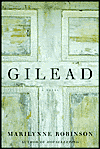
Gilead by Marilynne Robinson

In 1956, toward the end of Reverend John Ames's life, he begins a letter to his young son, an account of himself and his forebears. Ames is the son of an Iowan preacher and the grandson of a minister who, as a young man in Maine, saw a vision of Christ bound in chains and came west to Kansas to fight for abolition: He "preached men into the Civil War," then, at age fifty, became a chaplain in the Union Army, losing his right eye in battle. Reverend Ames writes to his son about the tension between his father--an ardent pacifist--and his grandfather, whose pistol and bloody shirts, concealed in an army blanket, may be relics from the fight between the abolitionists and those settlers who wanted to vote Kansas into the union as a slave state. And he tells a story of the sacred bonds between fathers and sons, which are tested in his tender and strained relationship with his namesake, John Ames Boughton, his best friend's wayward son.

This is also the tale of another remarkable vision--not a corporeal vision of God but the vision of life as a wondrously strange creation. It tells how wisdom was forged in Ames's soul during his solitary life, and how history lives through generations, pervasively present even when betrayed and forgotten.


Winner of the 2005 Pulitzer Prize, this book is not a book that you read if you want fast moving action. Ostensibly a letter to his young son, it is also a study of the faith of John Ames, particularly in the context of the relationships he had with his family, his parishioners, his best friend, and his namesake who is the rebellious younger son of his friend.

I particularly enjoyed reading of the struggles as John Ames tried to learn how to communicate with his namesake Jack Boughton. Jack is a man who never fitted in anywhere, even in his own family, and the persistence between the two to try and get to understand each other.

The writing is beautiful, and I am sure will touch many people, but for me, I think that this was not the kind of book that I needed to read at this particular moment. It was just too introspective I guess. There were magical moments scattered throughout though. An incident that happened in the late 1800's involving a horse getting stuck in a collapsing tunnel had me laughing out loud on the train, and the ending had me tearing up, once again on the train!

The reason why I read this book now is because it is this month's book in a group I read in. It's interesting looking at the dynamics of the group and seeing who enjoyed it compared to those who didn't. The discussion with this particular book tends to make the reading experience for me! So the rating below reflects my own personal reaction - I might review it later once others add their interpretation and I get extra insights!!

Rating 3.5/5

Wednesday, April 19, 2006

Pulitzer Prize winner - March by Geraldine Brooks

I was glad when I heard that this book had won the Pulitzer Prize. Maybe it is that the Pulitzer is a bit more accessible than some other prizes, but it seems to me that the winners, particularly this year's, are actually readable books that can be read and enjoyed for their story, not just for their writing or language!

I read March last year and highly recommend it! The story is written taking the gaps from the Louisa May Alcott classic Little Women and filling them in. The main character is Mr March, the father who is missing during the action in Little Women, off serving as a chaplain during the Civil War.


It helps that Geraldine Brooks is an Aussie as well, although I haven't seen too much excitement here in the press.
TEMPLATE CREATED BY PRETTYWILDTHINGS