




Showing posts with label Rome. Show all posts

Wednesday, September 23, 2020

Blog Tour: Mitchell James Kaplan on Why I Love Dreaming

Today I am pleased to welcome Mitchell James Kaplan to my blog as part of the blog tour for his new book Into the Unbounded Night. Welcome Mitchell!


¬¬¬¬¬¬¬¬¬¬¬¬¬¬¬¬¬¬¬¬¬¬¬¬¬¬¬


I am not going to tell you why I love dreaming. I don’t know why I love dreaming. I don’t even know what dreaming is. When I’m dreaming it is everything but when I’m awake it is nothing. It never happened. By the same token, when I’m dreaming, the world I inhabit while awake doesn’t exist and never existed. It’s as if I were given not one life, but many, all within the short span of years allotted to mortals. It feels like a rare privilege even though it may be a common and insubstantial one.

Fortunately, the “short span of years” is only a waking concept. Not a dreaming one. There is no such thing as time in dreams. That’s because there is no causality. Anything can happen, in any order. Dreams expand our lives beyond the finite.

I am not a person who enjoys flying in my dreams, or spying on friends, or exploring places I have never been. I do not aspire to have control over where I go or what I see. Sometimes I may think I am in charge of my dream-destiny but then something happens that robs me of that conviction. The same occurs in “real” life. The reasons for all the important events, including the circumstances of my birth, where I went to college, and how I met my wife, are beyond my understanding.

Lately my dreams have been dark. Everyone wears masks. A little boy, whom I had never seen in any world, walked up to me from out of a crowd and told me, “You will be dead by morning.” It felt so real. I woke with a start, roused my wife, and told her where I had stashed my life insurance policy. She muttered something and fell back asleep.

In the morning, I was not dead, as far as I know. But I remain convinced that little boy was telling me something important and I feel an urge to do something before it’s too late. Maybe I’ll go into an economically challenged neighborhood and find a kid to mentor. That would be something. Yes, I must do that.

Where did this desire come from? Is it a result of that dream? Do dreams even have a purpose? I have no idea.

What I do know is that who we are is a result of all our experiences, conscious and unconscious. We carry around this residue of our past—or rather, of our pasts. Every place we have visited, everyone we have met, in dreams as well as in “reality,” affects who we are today, how we got here and where we are going.

Some people live vertically, others horizontally. When you’re dreaming, you’re lying in bed. You’re living horizontally. When you’re climbing the corporate ladder, or any social ladder, you’reliving vertically. Maybe some people know how to do both but I don’t.

I am not going to claim that dreams are some kind of portal. I don’t know whether dreams suggest we have souls, or that there is life after death. For that matter, I don’t know whether emotions, including love, joy, and sadness, are real. The things that matter most are the things we cannot understand. Maybe they matter precisely because they defy comprehension.


About the book


INTO THE UNBOUNDED NIGHT
BY MITCHELL JAMES KAPLAN

Publication Date: September 1, 2020
Regal House Publishing
Paperback & eBook; 231 Pages
Genre: Literary/Historical


When her village in Albion is sacked by the Roman general Vespasian, young Aislin is left without home and family. Determined to exact revenge, she travels to Rome, a sprawling city of wealth, decadence, and power. A “barbarian” in a “civilized” world, Aislin struggles to comprehend Roman ways. From a precarious hand-to-mouth existence on the streets, she becomes the mistress of a wealthy senator, but their child Faolan is born with a disability that renders him unworthy of life in the eyes of his father and other Romans.
Imprisoned for her efforts to topple the Roman regime, Aislin learns of an alternate philosophy from her cellmate, the Judean known today as the Apostle St. Paul. As the capital burns in the Great Fire of 64 AD, he bequeaths to her a mission that will take her to Jerusalem. There, Yohanan, son of Zakkai, has been striving to preserve the tradition of Hillel against the Zealots who advocate for a war of independence. Responding to the Judeans’ revolt, the Romans—again under the leadership of Vespasian—besiege Jerusalem, destroying the Second Temple and with it, the brand of Judean monotheism it represents. Yohanan takes on the mission of preserving what can be preserved, and of re-inventing what must be reinvented.
Throughout Into the Unbounded Night, Aislin’s, Faolan’s, Vespasian’s, and Yohanan’s lives intertwine in unexpected ways that shed light on colonization and its discontents, the relative values of dominant and tyrannized cultures, and the holiness of life itself—even the weakest of lives.

REGAL HOUSE PUBLISHING | AMAZON | BARNES AND NOBLE | BOOK DEPOSITORY | INDIEBOUND

Praise for Into the Unbounded Night

“In Into the Unbounded Night, Mitchell Kaplan offers a rich rendering of war and humanity in first century Rome — of tradition and loss, and the transformative power of healing and collective memory to find one’s way home.” – Nichole Bernier, Boston Globe Bestselling author of The Unfinished Work Of Elizabeth D
“Mitchell James Kaplan is the gloriously talented writer of this dramatic, intense story of conflicting emperors, slaves, priests and exiles in a first century world whose roots and traditions are increasingly torn apart by the brutal rule of Rome. Men and women search for belief and reason, out of which will emerge a new Judaism after the destruction of Jerusalem’s Temple as well as the early beginnings of Christianity. A writer of enormous scope, compassion and poetry, Kaplan has written several of the most compelling characters you will meet in the pages of a book. Into the Unbounded Night sweeps over you like a succession of huge waves. It is truly a major novel.” – Stephanie Cowell, American Book Award recipient, author of Claude And Camille: A Novel Of Monet
“Kaplan’s prose is so rich and agile I felt I was breathing the air of these ancient places, and his evocation of character is no less palpable. Fully embodied and driven by ambition, grief, the clear-eyed desire for truth, and fierce maternal love, these characters plunge, march, and stumble toward their fascinating and entangled destinies.” – Marisa de los Santos, New York Times bestselling novelist of I’ll Be Your Blue Sky and award-winning poet
“I’m a big fan of historical fiction when it’s as good as Mitchell Kaplan’s Into the Unbounded Night. Vividly imagined, Into the Unbounded Night pulls the reader along with beautiful prose, strong characters and a wonderfully realized story.” – Heidi W. Durrow, New York Times best-selling author of The Girl Who Fell From The Sky, winner of the PEN/Bellwether Prize
“A beautiful, informative book. It was gripping throughout, the research never overwhelms the story, but is always part of it. [The] writing is lyrical and evocative of time and place. All the characters are real and interesting. Loved it!” – Martin Fletcher, National Jewish Book Award winner, author of Promised Land
“From the mystical lore of Albion to the Roman siege and destruction of Jerusalem, Kaplan’s meticulous research and evocative writing meld seamlessly to create a vivid, textured, and richly imagined story.” —Beth Hoffman, New York Times and International bestselling author of Saving Ceecee Honeycutt and Looking for Me
“Set in Rome and Judea after the crucifixion of Jesus, Mitchell James Kaplan’s finely crafted and intense second novel delves into the minds and hearts of truly captivating characters. An excellent read.” – Eva Stachniak, winner of the Canadian First Novel Award, author of The Chosen Maiden
“Sensually provocative, verbally sharp and critically witted, Mitchell James Kaplan’s Into the Unbounded Night brings to life the tumultuous birth of Judeo-Christian monotheism in this intimately woven narrative brimming with righteous and riotous characters striving for survival and transcendence across the ravished landscapes of Judea, the Roman Empire, and Britannia.”
– Jessica Maria Tuccelli, an Okra Pick winner of the Southern Independent Booksellers Alliance for her debut novel, Glow
“Kaplan weaves an intricate literary tapestry to create a poetic exploration of early Judeo-Christian and Roman history. He builds a diverse yet connected cast of characters whose encounters inspire timeless self-examination and advance the course of history. An engrossing work not easily forgotten.” – Therese Walsh, critically acclaimed author of The Last Will Of Moira Leahy and The Moon Sisters, founder of the literary blog, Writer Unboxed


About the author

Mitchell James Kaplan graduated with honors from Yale University, where he won the Paine Memorial Prize for Best Long-Form Senior Essay submitted to the English Department. His first mentor was the author William Styron.
After college, Kaplan lived in Paris, France, where he worked as a translator, then in Southern California, where he worked as a screenwriter and in film production.
He lives in the Blue Ridge Mountains of Virginia with his family and two cats.

WEBSITE | FACEBOOK | TWITTER | GOODREADS


Blog Tour Schedule


Monday, August 31

Review at Passages to the Past
Wednesday, September 2
Review at Books and Zebras
Friday, September 4
Review at Historical Fiction with Spirit
Saturday, September 5
Review at 100 Pages a Day
Monday, September 7
Review at Books, Cooks, Looks
Tuesday, September 8
Interview at Novels Alive
Feature at I’m Into Books
Wednesday, September 9
Review at YA, It’s Lit
Thursday, September 10
Review at The Caffeinated Bibliophile
Friday, September 11
Feature at Pursuing Stacie
Monday, September 14
Interview at Let Them Read Books
Wednesday, September 16
Feature at CelticLady’s Reviews
Thursday, September 17
Review at Chicks, Rogues, and Scandals
Friday, September 18
Guest Post at Book Bustle
Monday, September 21
Interview at Books & Benches
Tuesday, September 22
Feature at Coffee and Ink
Wednesday, September 23
Guest Post at The Intrepid Reader
Friday, September 25
Review at A Book Geek

Giveaway

During the Blog Tour, we are giving away 2 copies of Into the Unbounded Night! To enter, please use the Gleam form below.
The giveaway is open to US residents only and ends on September 25th. You must be 18 or older to enter.


Unbounded Night

Friday, June 01, 2012

Bookish Quotes: Poseidon's Gold by Lindsey Davis

Today my bookish scrollish quote comes from Poseidon's Gold by Lindsey Davis, the fifth book in the Marcus Didius Falco series of mysteries which is set in Ancient Rome. Marcus's voice often reminds me of a hard-bitten gumshoe detective but when you make that setting Rome it means that we get really fun reads! The fact that the voice and characterisations are so well drawn in the series, I can see myself reading all 20 books in the series in due course!

The quote comes from page 129-130

The judge lived in an impressive house of the type I could easily covet. Worse, his house might even convince me to aspire to his rank.

It was a detached town villa just off the Vicus Longus, not too large and not too small; it had some fine rooms for impressing public visitors, but was arranged for decent privacy. Marponius never went down to Petro's meagre guardhouse; he had felons brought here for interviews. He had a social conscience. He wanted lags like me to discover the urge to reform through seeing what could come from more legitimate types of crime. Compared to speculation and usury, mere theft and murder began to look unprofitable and quite hard work. Even being an informer seemed a dead-end job.

I presented my person at a ponderous marble portico. The elaborate studs and shiny bronze door furniture were overdone to my mind, but as an auctioneer's son I had seen that much of the world has unsubtle taste. Under the frippery, it was a solid hardwood door. The judge simply belonged to the group that likes to ruin good material.

Marponius and I would never agree on decor. I was a spare-time poet with a refined nature, whose occupation called for a sensitive, humane approach. He was a dull thug from the middle rank who had made himself rich, and therefore significant, by selling scientific encyclopaedias to New Men. By New Men I mean ex-slaves and foreign immigrants; people with overflowing coffers but no education who want to appear cultured. They could afford to buy literary works by weight - and more importantly, they could fit themselves up with ranks of literate slaves to read the works aloud. In the shifting social strata of Rome there was plenty of scope for applying gloss to upstarts. So if a treatise was Greek, incomprehensible and came in twenty scrolls, Marponius had his team of scribes copy it out. He used best-quality papyrus, black gall ink, and highly scented sandalwood for the end pieces. Then he supplied the slaves with refined voices too. That was where the money lay. It was a neat trick. I wish I had thought of it.

Tuesday, April 10, 2012

Teaser Tuesday: The Iron Hand of Mars by Lindsey Davis

It is no great secret that I am a sucker for a series. I have way too many going on to keep up with and every now and again one falls by the wayside. Actually, it is more regular than every now and again! This is one of those series for me.

I am a little ashamed to say that I actually read the first book in this series over five years ago. It took me nearly two years to read the second book, and now, five years after reading the first book I am finally reading the third book in the series. There are actually now twenty books in the series, so at this stage I should catch up in about...oh....forty years or so!

It was hard to find a teaser to share because the voice of Falco is just so pervasive and there were just so many that I could have chosen from the early part of the book. He is like a jaded gumshoe detective but instead of living in New York in the 1930s he is in Ancient Rome. Like many of those style of detectives, Falco is down on his luck, just scraping by financially, and he often has women trouble as well! If it isn't full on trouble, it is definitely complicated!

This quote comes from page 38:

One thing was certain. I had committed domestic sacrilege. Helena Justina might overlook many insults, but my bumming off to Veii on her birthday was not one of the. The fact that I didn't know it was her birthday was irrelevant. I should have done.

"Didius Falco, Caesar ... " Before I was ready to concentrate on political matters, a major-domo who reeked of long-standing vanity and recently braised onions announced my name to the Emperor.

"That's a long face. What's up, Falco?"

"Woman trouble," I admitted.

Vespasian enjoyed a laugh. he threw back his great head and guffawed. "Want my advice?"

"Thanks, Caesar." I grinned. "At least this heartthrob didn't run off with my armpurse or elope with my best friend..."

We hit a small moment of stillness, as if the Emperor had remembered with disapproval who my latest heartthrob was.

From the subtitle (Death Lies Beyond the River Rhine) and from the back cover blurb we know that Marcus Didius Falco is about to be sent to Germany so it's going to be hard to fix his domestic issues from that kind of distance!

Saturday, March 17, 2007

Dreaming the Eagle by Manda Scott

With a novelist's grace and a historian's power, critically acclaimed author Manda Scott brings her immense storytelling gifts to an epic work of historical fiction. Dreaming the Eagle breathes life into history, creating a vibrant portrait of the early years of the Celtic queen, Boudica. With haunting images and unforgettable characters, Scott draws us into a completely different world...a world of myth and heroism, beauty and brutality...where a young woman journeys to greatness at the crossroads of history...


She is Breaca nic Graine, born to the Eceni, a tribe of dreamers and hunters, storytellers and artisans. While fierce in battle, they are a peaceful people, men and women of pride and mystery, in whose lives the real and the fantastical exist side by side. But theirs is not a peaceful world; it is a world of bloody conflict, where neighboring tribes war among themselves while a greater enemy gathers strength across the ocean.. Against this seething backdrop, Breaca will come of age and prove her brilliance in battle, catapulting her to the forefront of her tribesmen, who will rename the copper-haired warrior: Boudica:"She Who Brings Victory."

Many will share in Breaca's extraordinary destiny... Eburovic, the beloved father who always knew that his impetuous firstborn was destined for greatness... Caradoc, the legendary warrior whose love for Breaca is rivaled only by his hatred of Rome... Corvus, the Roman soldier who will become a powerful - and unlikely - ally. Soon as violence and treachery threaten a fragile peace, as an emperor named Caligula rises to power in a distant land, Breaca will once again be called to battle. And this time, the future of a people will rest in her hands as she faces a near-impossible task: to rally the splintered Celtic tribes against the encroaching might of Rome.

Filled with breathtaking sights and sounds - from the beauty of an ancient tribal ritual to the blood lust of a gladiator's arena, from the deafening roar of battle to the quiet passion of lovers - and brimming with raw adventure and vivid historical detail, this magnificent novel has it all: mystery, passion, hatred, lust, war, romance, miracles. It is a work of masterful storytelling by one of the most exciting and original new voices in historical fiction.


Wow...that is an extensive inside cover flap copy, and to be honest I am not going to regurgitate any of the story because this covers it mostly adequately.

The book is broken into four parts. I found the first part quite slow going, where the author was setting up all the meaning of the dreaming, the way that the tribes interacted with each other, and with their animals, and the basis of the warrior training that Breaca received. Once the story moved into the 2nd part and beyond, the story picked up pace and it was easier to get sucked into the story.

There are a couple of things that I think that were misleading in the blurb above. The first is from the final paragraph, where it talks about the "quiet passion of lovers". If you go into this book expecting to read a balance between the history, and the romantic attachments of the main characters then you will be disappointed. The romantic outcome is telegraphed from very early in the book. By the time I was getting towards the end of the book I was actually expecting that this part of the story would be carried into the next book, instead of the inevitable happening in this book.

It is also interesting that there is no direct mention of Breaca's brother Ban in the blurb either, because in many ways his story is the counter balance to Breaca's own. He is a major character, and there were significant chunks of the narrative where the focus was on Ban, and not on Breaca.

There were many, many characters, and at times I really had to struggle to keep track of some of them, and to be honest I think the author did too. There was one fairly major protagonist who was dealt with, but there was absolutely no reaction whatsoever from any of the other characters, which given his role in things was very, very surprising at least to me.

This is no light and fluffy account of what have may have happened - it is in turns gruesome and harsh, mystical and reverent and very believable.

For me there is an inevitable comparison to be made to the Jules Watson books I have read, The White Mare and The Dawn Stag. The settings are not identical but I would think it is fair to say that the tone and intentions of the books are very similar, even though there are several distinctions between them. I think that Jules Watson's books are better able to sustain an emotional involvement on the part of the reader, but there is less reliance of the fantasy elements in this book. It is not that the fantastical, mythical parts of the story aren't there, but I do think there is less reliance on them to move the plot forward.

The hook at the end of the story for the next book is definitely well and truly there, and I for one have been caught on it! The next book has already been picked up from the library!

Rating 4/5

Wednesday, January 10, 2007

The Silver Pigs by Lindsey Davis

Rome, AD 70. The city melts under a scorching August sun. For Marcus Didius Falco, hard-bitten private investigator the summer holds few prospects other than spying on the faithless wives of the Empire's senators - and his broom-wielding mother sweeping out the latest rope dancer with the dust from his seedy sixth floor aparetment.

One day in the Forum, Falco comes across the very young, and very beautiful, Sosia Camillina. Saving her from the unwelcome attention of two jelly-brained thugs with kidnapping in mind, the chance encounter seems to open new horizons. But Rome is going through a critical and turbulent period. And somehow working on Sosia's behalf proves to be less straightforward that Falco could possibly guess. The appearance of a stolen silver pig (a silver-bearing ingot of lead) leads Falco to a plot to overthrow the new Emperor, Vespasian. Not that Falco cares over much for those who run the state, but th eprospects of Sosia and incoming funds proves irresistible.

Then a murder which dents even Falco's well-worn cynicism makes discovery of the conspirators his only reason to live - even if it does mean the dismal prospects of a country he had hoped to never see again.
Britain in winter, the Mendips lead mines. Disguised as a slave, Falco is treated with harsh contempt and cruelty, putting his life in danger as he discovers how, and by whom, the ingots are smuggled. Add to that the firy pride of Helena Justina, the disdainful daughter of Sosia's senator uncle, and Falco's hardships double.

The discoveries Falco makes in this bleak land draw him inexorably into the heart of treachery and conspiracy at the highest levels. His return to Rome leads him further into the labyrinth of political greed - and love.

Written with the same dry humour as an American gumshoe novel and with an unerring eye for historical detail, The Silver Pigs introduces a serial hero in Marcus Didius Falco who could be Ancient Rome's answer to Philip Marlowe and Sam Spade.


And you thought that those books that I have listed for the From the Stacks challenge were just there to look pretty. Nope. It really IS my intention to read them.

Having said that, I am going to cheat big time and link to Rosario's review of this book. It is soooo darn hot here I can't think, and it is going to stay this way for at least another day. No sleep here tonight unfortunately!

I will say that one of the criticisms that I have heard from a couple of people about this series in general is that the main characters sounds too much like a modern American gumshoe detective, and he does, but that is completely part of the charm for me! He's so self deprecating and funny that you can't help but fall a bit in love with Marcus Didius Falco!

My rating: 4/5

Wednesday, November 22, 2006

The Dawn Stag by Jules Watson

This is the second book in the Dalriada trilogy that started with The White Mare


AD 81. Agricola, the ruthless governor of Roman Britain is intent on capturing the last unconquered territory in Britain - Alba, Scotland.

Rhiann is an Alban priestess and princess who submitted to a political marriage to Eremon, an exiled Irish prince. Out of duty, grew love - a powerful and desperate love that will bind them together through conflict and betrayal. Now in them lies the hope of a nation. For Agricola's army is formidable - brilliantly armed and heavily supported. To the people of Alba it is a wall of steel and fire advancing across their homeland, bringing with it desolation.

The predestined day draws near: the armies of Alba and Rome will meet in an epic battle to decide the fate of a country. Rhiann searches for guidance in the spirit world, little realizing how big a part she will play in this endgame. Eremon knows only that he must risk - and sacrifice - many lives, perhaps even his own.


I read The Dawn Stag a couple of months ago and was quite surprised at how much I enjoyed it. Whilst I like the idea of reading about Rome, I haven't actually read that many! But combine Scotland (or Alba as it is known in this book) and Rome and I am definitely interested.

This book takes up where The Dawn Stag left off and covers a period of approximately three years. In the summer months there are battles to be fought against the increasingly frustrated Romans, and in the winter time to recover and to be together, focussing on what it is that they are fighting for - a free Alba.

Whilst the story of Rhiann and Eremon is definitely interesting, and one that I wanted to follow, the author does not forget about the secondary characters. There is love and there is loss, happiness and heartache. The other interesting character was Agricola, the leader of the Romans. He is facing a huge loss of prestige and reputation if he cannot defeat these uncivilized warriors and soon, yet he gets drawn into losing battle after losing battle, and becomes increasingly frustrated.

I have to say that to me it felt like there was a greater focus on the mystical in this novel. Rheann is Ban Cre - not only the carrier of Royal blood, and possibly mother to one of the next leaders of her people, but also their spiritual leader. It is Rheann who must reconcile herself with the events of her past and find her way back to the Goddess, who must draw the other tribes together to fight in unison with the forces led by her husband to give them any chance to defeat the enemy, who must fight to save lives, including some of those that she loves.

The relationships are well written, and the events, about which is really known, feel real and compelling. The only thing about this book that concerned me was really the ending. There is a third book out in this trilogy in May next year called The Boar Stone, but it really felt as though the story was all wrapped up in this book. Having read the synopsis I guess I have an idea of how the third book will tie in with the first two books, but I suspect that for the most part we have seen the last of Rhiann and Eremon, and the other's that we have come to know and love from Dunadd. If not for the ending, this book probably would have ended up with the same rating as the first book, which was 4.5 out 5.

Instead, I am giving it a rating of 4/5

Tuesday, September 05, 2006

The White Mare by Jules Watson

AD 79. Agricola, the ruthless governor of Roman Britain has just subdued the Welsh. Now he has turned to the last unconquered territory in Britain - Alba, Scotland.

For Rhiann, an Alban priestess and princess, the thread of invasion changes her life irrevocably. The king, her uncle, has no heir, and it is her duty to submit to a political marriage. But she is emotionally scarred from a terrible trauma, and can imagine nothing worse than matrimony. Desperately, she looks for a way out, but sees only the Romans closing in.

Into this volatile situation sails an Irish prince, Eremon, exiled from his home by familial treachery. His aim is to win renown and regain his throne, but first he has to deal with an unexpected alliance, prove himself a military leader, and unite the feuding tribes of his adopted country.

Against this backdrop of looming war Rhiann finds herself embarking on an unexpected journey of love and loss that will the true purpose of her life.

The White Mare is the first novel in the Dalriada Trilogy and marks the arrival of an exciting new talent in historical fiction. In the grand tradition of the saga, it is a tale of heroic deeds, of kinship and kingship, and the struggle for power, honour, freedom, and love.


One of the things I love about reading is the way that you can travel to other places and/or times, without actually leaving modern comforts behind!! This book transported me to Scotland (Alba) in AD 79. The Roman forces are massing in the south of Alba waiting for the order to be given to conquer the wild tribes of the north once and for all, given Rome control over the whole of the mainland Britain.

With the prospect of war looming, Eremon arrives. He is fleeing from a usurper that has taken his rightful place as King from one of the tribes of Ireland, and is looking for a place to spend time regrouping until he can go and take back what is rightfully his. His plan is to make a name for himself, and one way that can happen is if he becomes war leader of the tribes. However, that will take some doing, because the tribes of Alba are notorious for their ongoing feuds and battles. Eremon sees that the only way to defeat the Romans will be to be fighting as one cohesive unit, and works his way towards that girl.

Rhiann is a princess and also a priestess, and she has one pressing duty - to provide a royal heir. Quite interestingly, author chooses to have the crown pass through the females of the family, so that if Rhiann has a son, then he will become King, instead of the more traditional way of passing the crown from father to son. Rhiann is a leader of her people and a very strong woman, in all ways except one. She is traumatised from events that happened several years ago where her foster family was all killed, and she herself suffered terribly. These events have left her with a terrible distrust of men, and warriors in particular.

When it is agreed that a political match be made between Rhiann and Eremon, she is terrified of what is to come, and for a long time after the wedding she maintains a completely distant persona. Gradually though, Eremon and Rhiann begin to work together for the good of the people of Alba, although it is fair to say that there are setbacks along the way. They also work together towards healing of both their relationship and their minds.

The author doesn't back away from the faults of the characters, moving the story forward through the mistakes and errors in judgement that occur.

With a strong emphasis on the role of fate and on the role of religion during those times, there is almost a mystical feel to this book. It has to be said that I haven't read a lot about Roman times, or the tribes of the time, so I have no idea how feasible some of the ideas are that are presented in the book, but they seemed reasonable enough to me as I read it. What I look for in a book is readability, and for a story that hooks me in and makes me want to keep reading. Using these two as measurements, this sprawling sage is a winner!

I enjoyed it immensely and I will definitely be reading the sequel, The Dawn Stag, and the final book in the Dalriada trilogy, which is due out early next year.

Rating 4.5/5

Monday, July 03, 2006

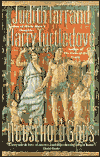
Household Gods by Judith Tarr and Harry Turtledove

Nicole Gunther-Perrin is a modern young professional, proud of her legal skills but weary of childcare, of senior law partners who put the moves on her, and of her deadbeat ex-husband. Following a ghastly day of dealing with all three, she falls into bed asleep...and awakens the next morning to find herself in a different life, that of a widowed tavernkeeper in the Roman frontier town of Carnuntum around 170 A.D.

Delighted at first to be away from corrupt, sexist modern America, she quickly begins to realize that her new world is a complicated as her old one. Violence, dirt, and pain are everywhere - and yet many of the people she comes to know are as happy as those she knew in twentieth-century Los Angeles. Slavery is commonplace, gladiators kill for sport, and drunkenness is taken for granted - but everyday people somehow manage to face life with humor and good will.

No quitter, Nicole manages to adapt to her new life despite endless worry about the fate of her children "back" in the twentieth century. Then plague sweeps through Carnuntum, followed by brutal war. Amid pain and loss on a level she had never imagined, Nicole finds strength she had never known.


Having never read either of these two authors before, I came to this book without any preconceptions about the characters, the story, or anything like that. I was attracted to reading a story about finding yourself in a different time and place, and given that I tend to read historical fiction based in England, Ancient Rome was certainly a fresh focus for me.

Firstly, what did I like about this book? Reading about the life of an ordinary Roman woman was very interesting, along with many very interesting little tit bits, like the fact that many of the Roman statues were actually painted in very gaudy (and not necessarily tasteful) colours. The description of the smells and sounds of a busy Roman town were very vivid, as were the descriptions of the hardships that Nicole faced as she lived her life in the body of Umma, tavern keeper.

So, if those were the things that I did like, what didn't I like? Well, unfortunately, I didn't really ever warm to Nicole. During the first part of the book when she was in Los Angeles, I wanted to slap her, and say "Look, you aren't the only single mum out there trying to deal with all these issues". Then, when she got to Carnumtum, I wanted to slap her even more, if that's possible. The 20th century Nicole was pretty uptight a lot of the time, and she took that to the nth degree in 2nd century life. Her father had been an alcoholic and so she had never had a drink in her life, so when her slave Julia presents her with a cup of wine she thinks nothing of pushing it away and drinking water, and making "her" two children, also drink it, meaning that they all got sick. She was constantly making reference to the lead in the water pipes, in the makeup, and hygiene conditions in the town. Now, if someone was to really end up at that point of time, I am sure that they would be appalled by the conditions in the same way as Nicole was, but it felt as though I was being hit over the head over cricket bat over and over and over again with all the mentions of those types of issues.

It was interesting to watch as Nicole got to know all of the people that the previous Umma already knew, including her family, her slave Julia, her children and her boyfriend.

I guess for me the fact that I couldn't get to like Nicole all that much is a really big problem for this, so my rating reflects the fact that whilst I did like quite a lot about this book, there was one major flaw. Another less major flaw was that we found out what happened to Nicole's body while she was in the past, but there was never any mention at all about what happened to Umma whilst Nicole was being her. It would also have been interesting to watch Umma try to work out exactly what Nicole had done whilst she was Umma - like inexplicably being able to read Latin, and then when they were returned to their normal states, the fact that Umma once again wouldn't be able to read, and most particularly Umma's thoughts when she realised that Nicole had freed her slave.

One interesting thing, if you google for Carnumtum you can see images of the ruins of this actual Roman settlement which are located not too far from Vienna in Austria.

Rating 3/5
TEMPLATE CREATED BY PRETTYWILDTHINGS