Showing posts with label Ann Patchett. Show all posts

Sunday, March 03, 2024

Six Degrees of Separation: Tom Lake to A Game of Thrones


Welcome to this month's edition of Six Degrees of Separation, which is a monthly meme hosted by Kate from Books Are My Favourite and Best.  The idea is to start with a specific book and make a series of links from one book to the next using whatever link you can find and see where you end up after six links.  I am also linking this post up with The Sunday Salon, hosted by Deb at Readerbuzz. 


This month we are starting with Tom Lake by Ann Patchett. I feel like I could have gone in a lake direction and pretty much have done the whole chain based on that theme, but in the end I took a different direction.


I decided to use another book by Ann Patchett as my first link and I have chosen The Dutch House


Recently I bought a book that has easily identifiable Dutch houses on the cover - Midnight Blue by Simone Van Der Blugt. I am looking forward to reading this at some point. When I do read it, it will count towards the Books in Translation challenge as it is written by a Dutch author..


I went looking for a book with the word blue in it, and found The Lady in Blue by Javier Sierra. This is another book in translation, this time by a Spanish author. 


If you were ever to ask me to name a Spanish author, then the first one that would come to mind would be Carlos Ruiz Zafon. I loved his book The Shadow of the Wind so much!


Another wind named book that I absolutely loved was The Name of the Wind by Patrick Rothfuss.


Patrick Rothfuss is a somewhat famous, or maybe infamous, for being a bit grumpy when people ask when are we ever going to see the next book in the Kingkiller Chronicle series. Another author who is the same is George R R Martin, so I am finishing with A Game of Thrones.


Next month the starting point is a bit different. Kate's instructions are to "look to your bookshelf – do you see a Lonely Planet title there? Or an Eyewitness Travel title? Or any other travel guide? That’s your starting book." I don't think that my starting point will be a surprise to anyone who knows me at all!


Tuesday, July 21, 2020

Top Ten Tuesday - Writer's I've Seen at MWF


Welcome to this week's edition of Top Ten Tuesday which is hosted by That Artsy Reader Girl. This week's theme is Book Events/Festivals I’d Love to Go to Someday (Real or Fictional) which was  submitted by Nandini @ Unputdownable Books)

Is it too much of a cop out to say all of them? It feels like it is!

I am very lucky to live in a city which was the second city in the world to be named as a UNESCO City of Literature and there are plenty of festivals or conferences around the city. The main one, the Melbourne Writers Festival, is announcing it's line up and format tomorrow! If the program had been released today then my Top Ten post would have been about that, but instead, it is out tomorrow, so instead I have decided to use my post this week to talk about some of the authors who I have heard speak in previous years.

I have been going to Melbourne Writers Festival for around 10 years now. Not only have I had the chance to listen to some great authors speak, but also I have been able to meet up with other book bloggers over the years. Some of the authors I have heard speak at MWF include:


Ann Patchett - I saw Ann Patchett back in 2011, where she was talking about her book State of Wonder. I did enjoy that book. I do still need to read her newest book The Dutch House too.


Sarah Dunant - I saw a couple of sessions with Sarah Dunant back in 2013 and both were fascinating. The first session was talking about Italian art and history, with a particular focus on Lucrezia Borgia. I got her book, Blood and Beauty, at that time. Still haven't read it!


Kate Grenville - I saw a session with Kim Scott and Rohan Wilson back in 2011 talking about the challenges of writing about the settlement of Australia, particularly in relation to native Australian portrayals. Kate Grenville has a new book out and looking at the current MWF website, I would suggest she is going to be a featured author again this year.


Kim Scott -After hearing Kim Scott speak in the same session as  Kate Grenville, I knew that I had to read his book That Deadman Dance, which I thought was excellent.


Kevin Kwan - Kevin Kwan was a speaker in 2013at as session which focussed on books as objects of beauty which was fascinating.


John Boyne - This session was memorable for a couple of reasons. Firstly because I could have listened to him talk for hours, but also because a friend of mine who lives in Sydney happened to walk in and sit down in front of me. I had no idea she was in Melbourne, and for her it was a impulsive decision to attend a session.


Melina Marchetta - This was one of the sessions I attended last year because I do love her books! And I would totally go and listen to her talk any time!


Justin Cronin - In 2016 I attended several MWF sessions, including Rainbow Rowell and David Leviathan, but for the purpose of this post I am going to mention seeing the author of the Passage trilogy.


Susan Johnson - I saw Australian author Susan Johnson speak back in 2013 at a session called Sex and Sensibility. You know that a session exploring sex and sensuality in literature is going to be fun, which it was!


Margo Lanagan - My final author for today's post is another Australian author, Margo Lanagan who I saw speak back in 2013.


Back in the day I was very diligent and wrote recaps of many of the sessions I attended which you can revisit through the links I have included above. The last couple of years I haven't written anything! Whoops! This year I will try to do better and do something between those two extremes.

Oh, and in answer to the actual question for this week, in addition to all the Australia capital city festivals (Perth, Adelaide, Sydney etc) I would like to visit the Ubud festival in Bali, Hay on Wye festival in the UK, and Book Expo America. Closer to home there is a small town in country Victoria called Clunes which has an annual weekend festival which I would like to visit one day.

Sunday, July 05, 2020

Six Degrees of Separation: What I Loved to A Guide to the Birds of East Africa

Welcome to this month's edition of Six Degrees of Separation, which is a monthly meme hosted by Kate from Books Are My Favourite and Best.  The idea is to start with a specific book and make a series of links from one book to the next using whatever link you can find and see where you end up after six links.  I am also linking this post up with The Sunday Salon, hosted by Deb at Readerbuzz.


The starting point this month is What I Loved by Siri Hustvedt, a book I don't recall hearing about let alone reading. When I was thinking about what my strategy was going to be in relation to this book, it was almost as though I then thought, "and how exactly can I make this even harder for myself", and a plan was hatched.

My starting point was to think about what Siri Hustvedt's background was, and it turns out that she is an American author, whose family background is Norwegian, so then I thought about what other books I had read either by a Norwegian author or set in Norway, and the first one that came to mind was The Storm Sister by Lucinda Riley, which is the second book in the Seven Sisters series. A lot of the action in this book took place in Norway so this was my first step.

Where I complicated it for myself was then I decided that my links for this month would be based on the books in the Seven Sisters series. I could have done just the books in the series - there's an obvious link - but that would be a bit boring right. So my twist was that my selections will be based on the settings in each of the books from this point on.


The first book in the series is The Seven Series. In the historical part of the novel, we learn the story of how the Christ the Redeemer statue was created. A lot of the book was set in Brazil, but there were significant portions of the book that were set in Paris as the statue was being designed. The only book that I can think of that I have read that was set in Brazil was State of Wonder by Ann Patchett.


The second book in the series is The Storm Sister, which was my link to What I Loved in the first place. This book is set primarily in Norway and looking at the history of Edvart Grieg, the man who composed the music for Henrik Ibsen's play Peer Gynt.


The third book in the Seven Sisters series is The Shadow Sister. This time, the historical section of the book focuses on a young woman who is friends with Beatrix Potter. The modern part of the book focuses on an antique book and life in the country. The characters are looking for a hidden family treasure which reminded me of The Peacock Summer by Hannah Richell where an old house hasn't given up it's secrets yet.


The fourth book in the series is The Pearl Sister which has a significant section of it's story set in the far north of Western Australia. I thought I would choose a contemporary novel - The Girl in Steel-Capped Boots by Loretta Hill. This was one of the early rural romances I read, and I think it would easily stand up to a reread. I certainly have good memories of this one.


The fifth book is the one that I am listening to on audio at the moment - The Moon Sister. This time the author is exploring the history around flamenco dancing in Spain. For another historical fiction novel set in Spain I have chosen The Last Queen by C W Gortner about Juana, the sister of Catherine of Aragon, who married into the powerful Hapsburg family.


The latest book in the series, the sixth, is The Sun Sister. I haven't read it yet, but I understand that it is set in Africa, so for my final choice I am revisiting a lovely book that I read many years ago, A Guide to the Birds of East Africa by Nicholas Drayson. This was such a delightful read which I thoroughly enjoyed but I had forgotten all about!

I have taken us on a journey around the world from Norway to Kenya using the books in the Seven Sisters series by Lucinda Riley as the compass.

Next month's starting point is How to Do Nothing by Jenny ODell. Maybe I will keep it a bit simpler next month, but maybe not. We'll see.

Where has your six degrees taken you this month?

Tuesday, May 29, 2012

Winner of State of Wonder by Ann Patchett

Congratulations to

Beth from Too Fond

who won the giveaway of State of Wonder by Ann Patchett!

Hope you enjoy the book when you get it Beth!

Monday, May 21, 2012

State of Wonder by Ann Patchett (includes international giveaway)

Dr Marina Singh was studying to be a doctor. After a terrible incident, she gives up that course of study and instead becomes a pharmacologist, studying cholesterol. She works for a drug company, is involved in an secret affair but other than that we don't know a lot about her. If I was to use one word only to describe her I would say that she was repressed.

She normally works closely with her lab mate, Dr Anders Eckman, but months ago he had been sent to the jungles of the Amazon to try and track down the woman who was previously Marina's lecturer, Dr Annick Swenson. Dr Swenson is in the Amazon working on developing a lucrative new medication but she is something of a maverick. She won't respond to requests for updates on where she is up to with her research and so the company have sent Dr Eckman to find out exactly how her research is going and more importantly when this drug will be ready for testing.

When they receive notification that Dr Eckman has died and been buried in Brazil, his widow wants to know more about the circumstances. Her employer still wants to know about the research project and so Marina is sent south to find out more..

In terms of setting, there are three distinct sections in this book. The first part of the book is set in Minnesota and in this world Marina is very controlled in almost every way. The first stop on her journey to the Amazon is Manaus in Brazil where she spends several weeks whilst she waits for the appearance of the mysterious Dr Swenson. Whilst there she spends time with an Australian couple, the Bovenders, who run interference for Dr Swenson, trying to stop anyone from finding where she is, what she is doing and from generally disturbing her in any way. Finally, she makes it to the research station in the jungle on the banks of a tributary of the Amazon where there are many surprises in store.

Whilst Marina undertakes a physical journey, it is more the philosophical and emotional journey that forms the core of this book. She loses her luggage more than once, and each time she becomes less reliant on her westernness and in effect ends up stripped back to her bare soul.

The research that is being undertaken is perceived  to be leading to a wonder infertility drug. The women of the tribe are able to sustain healthy pregnancies well into their seventies, but there is more happening at the station than just that research and the scientists working there are doing their best to keep the other research secret until the time is right. There is discussion of the moral and ethical responsibilities related to medical research and about bringing Western ways to the remote tribes but I never found those elements to be too dry or inaccessible.

I don't want to say too much more because part of the beauty of this book is watching the story unfold.

What a surprise this book was! I had only listened to one Ann Patchett book previously (Bel Canto) and I really didn't like it. I am not sure if it would have been different if I had of actually read the book, but I thought it was slow and a bit pointless.

So why did I volunteer for this book tour then? When this book first came out, I heard Ann Patchett on several podcasts that I listen to and each time I heard her I became more and more interested in the book. Then she was one of the big name guests to appear at last year's Melbourne Writer's Festival and I went to hear her talk. She is so good in a crowded room - funny and charming, engaging and passionate about writing and books.  It was a case where despite not liking the only book I had read from the author, I liked the author and so I was prepared to give her another go. I am so glad that I did.

I thoroughly enjoyed this book and found it much more of a page turner than I was expecting it to be. The topics discussed were interesting without feeling overwhelmed with the scientific details. There was adventure and drama - a particularly gruesome scene with a snake had my heart racing - and whilst a lot of the characters were not people I would particularly like if I met them, there is a young deaf boy named Easter who has made his home in a little corner of my heart. I enjoyed reading the way the author bought a group of individuals together to form a small community in an isolated place.

If there is a weakness in the book, it was the ending which didn't totally work for me, and I know that there are lots of other reviews out there which talk about the ending being a let down and this was one of the big issues I had when I listened to Bel Canto. I enjoyed the journey so much though, that I can live with the ending, mainly because I am not sure how else the story could have been all wrapped up. We are left not knowing where Marina goes next in her life, but that is okay because I was left feeling that she knew a lot more about herself at the end of the book than she did in the beginning.

I was so pleasantly surprised by how much of a page turner I found this book. Am I brave enough to try other Ann Patchett books? Maybe in due course, but for the time being I want to savour this reading experience.

4.5/5

Synopsis


In a narrative replete with poison arrows, devouring snakes, scientific miracles, and spiritual transformations, State of Wonder presents a world of stunning surprise and danger, rich in emotional resonance and moral complexity.

As Dr. Marina Singh embarks upon an uncertain odyssey into the insect-infested Amazon, she will be forced to surrender herself to the lush but forbidding world that awaits within the jungle. Charged with finding her former mentor Dr. Annick Swenson, a researcher who has disappeared while working on a valuable new drug, she will have to confront her own memories of tragedy and sacrifice as she journeys into the unforgiving heart of darkness. Stirring and luminous, State of Wonder is a world unto itself, where unlikely beauty stands beside unimaginable loss beneath the rain forest’s jeweled canopy.

Tour and giveaway details


See what other participants on this blog tour thought of this book by following the tour

Tour schedule 
Ann Patchett's website 

I am very excited to offer up a in international giveaway of the paperback of this book! To enter, leave a comment including your email address.

Giveaway closes 28 May 2012

Sunday, September 04, 2011

Sunday Salon: Feeding my soul at MWF


Earlier this week I went to a corporate lunch where they had an inspirational speaker come in and talk whilst we ate good food (seriously good dessert!). The man that spoke to us this time was a former police pathologist who had been involved in the aftermath of lots of different tragedies around the world helping with the terrible task of trying to identify bodies - events like the 2002 Bali bombings, the 2004 tsunami and more. At first when we read his bio we were a bit worried about what he would talk about. It turned out to be an incredibly inspiring speech. From his work in Thailand after the tsunami, he ended up starting a charity to help orphans and that charity continues to grow and grow and grow. When he talked there was barely a dry eye in the house (and the majority of the crowd were men in suits).

There were three things that he said that really stuck with me. The first was "Hope is not a plan" meaning you actually have to do something, you can't hope it will get done. The second was "You can't change what has happened but you can change what happens next" and the third was that we need to be doing things that feed our souls. My instant reaction to this last point was to think of really big things - like travel to Europe etc.

Yesterday though, I was sitting in my first session for the day at Melbourne Writer's Festival, and I came to the realisation that just by spending the day at Melbourne Writer's Festival I was feeding my soul!

Given the length of the introduction, I am thinking that this is going to be a very long post! Here is my account of how I fed my soul!

My first session of the morning was with In Conversation with Ann Patchett, author of books like Bel Canto and most recently State of Wonder. Now like last week, I went to see Patchett even though I wasn't particularly enamoured by the one book of hers that I had read. I had however really enjoyed listening to several interviews with Patchett and knew if nothing else  I would be amused as I listened to her, and I was right!

After a bit of Aussie celebrity name dropping, Patchett started to talk about the inspiration behind her newest book, State of Wonder, a book which is about an adult meeting a former teacher who was influential in their lives, and yet often those same students are invisible in the memories of the teacher. Patchett says that the book is a mix of mystery, adventure, science and fiction (not science fiction) and loss.

Some of the interesting things that she touched on:


  • Patchett is very interested in chapter structure. She likes to have the reader wanting to read to the end of the chapter, and then just one more chapter etc.
  • She is cold-hearted about her own work (which she credits as being a legacy from her years as a journalist). You must do what is best for the work, not necessarily for you.
  • Her research trip to the Amazon including insects and snakes
  • The difference between writing a novel and a memoir and how writing the memoir about her friendship with her best friend was cathartic
  • She has known since a very early age that she wanted to be a writer - no question of doing anything else for her.
  • The bookshop that she is about to open in Nashville (She doesn't want to live in a city with no bookshops). She did say that she wasn't likely to be working in the shop. Rather, she will be at home handcrafting the merchandise.


One of the more interesting parts of the discussion was the idea that as an author she has just one story to tell - the story from her heart and the further away from the heart you get the more that the author will struggle. She can dress it up with different settings and characters, but her books are mostly are about a group of strangers getting stuck in an unusual situation and forming a family. She also has common themes that she likes to explore. Two examples - race and the intersection between wealth and poverty. It was interesting to hear her talk about being able to write in the voices of different ethnicities, which she says can be done as long as you do it right, but also that she writes the individuals as individuals not as a representative of entire nationalities.

This was a fun session and Ms Patchett was really very charming and funny! I am glad I went, and now I want to give her books another go!

The second session I attended was Slow Travel

In Tom Trumble's Unholy Pilgrims he travels across Spain on foot, while Ken Haley's Europe@2.4km/h finds him traversing the continent in his wheelchair. They talk to Jane Sullivan about what you see when you take the slow road.
Once upon a time I used to read a lot of travelogues or books about starting a new life in a new country but it's not quite so common for me anymore (although not too long ago I did read Lunch in Paris).

Tom Trumble decided to walk Camino de Santiago because he was hoping for a bit of inspiration in terms of what he was going to do with his life. He walked 800km from France to Santiago de Compostela in Spain with a friend, meeting up with many other pilgrims along the way, and as most Australians are reputed to do along the way spending lots of time drinking! He stayed in the alberques that line the route and that bought with it the joys and otherwise of sharing space with others - Tom talked about finding the snoring particularly difficult to deal with. Contrary to what he initially expected, the worst part of the trek was the 250km section of flat terrain, where people begin to internalise more and as a result lots of interesting things happen. He talked about some of his fellow pilgrims and their pilgrimage as everyone does it for their own reasons.

Ken Haley is a paraplegic who was piqued by curiosity to discover more about the identity of Europeans and really discovered that for most Europeans they are still predominantly French or Spanish or whatever and that being European is still a somewhat distant concept. Of course, being in a wheelchair brings its own sets of difficulties - things like not being able to find many wheelchair friendly hotels in Paris for example.

Both talked about the devastation of losing some of their source documents (journals, photos etc), the road to getting published and their next projects. Tom talked about the fact that the experience of the pilgrimage didn't change him, but writing the book about it certain did! His next book is about a trip he made to Timor, and Ken's is another traverse of Europe with different start and end points!

Have to say, I am surprised that I could read any of my notes for this session as the venue was completely blacked out and so I couldn't see what I was writing!

After a long and chatty lunch with Lisa (thanks again Lisa - getting to know you a little has been one of the highlights of my festival experience!), a wander through the art gallery and some reading time, it was time for my next session.

My one disappointment of the day was the cancellation of the In Conversation with Shaun Tan session. The Ann Patchett session and his session were the two that I had built my day around, but these things couldn't be helped. The session I chose to attend instead was In  Conversation with Arnold Zable - a Melbourne author that I have been intending to read for a long time.

After beginning with the acknowledgement to the traditional land owners and the acknowledgement of the empty chair for PEN (which I mention because it didn't happen in all of the session I went to) the session started with Arnold Zable talking a little about his own background as a second generation Australian -  a child of Polish Jewish immigrants. His mother was often left distraught by the past and it affected her whole life. She left home not realising that she would never see her family again and Zable's father lost his entire family. Zable's background often informs his characters and stories, particularly in the composite characters that people his stories.

Zable's stories are often of the dislocated either emotionally like his mother who was broken by her past and his father who became something other than he was in order to support his family and only went back to his Yiddish poetry at the age of 70, or physically as in the case of refugees. 

Both Zable and the chair of the session , Julian Burnside QC, are passionate advocates for refugees and this was clear, especially when they talked about one of the survivors of the Siev X which was a people smuggling boat which sank back in 2001 with the loss of more than 350 lives - an event which became politicised in a shameful way in my opinion.

I loved the language that was used during this session  - Burnside talked of eloquent and elegant episodes and emotional truths and Zable talked of the joy of storytelling, the art of weaving different threads together to create stories, about scene construction, about story telling being a very sensual experience, the role of music for the author and reader and more.

The final session of the day for me was The Connected Book:

Now that we've accepted the ereader, it's time to look at some of the creative possibilities afforded by digital texts. Publisher ofBooksquare.com Kassia Krozser (US), author of digital fiction Inanimate Alice, Kate Pullinger (Canada), and founder of online digital library LibriVox Hugh McGuire (Canada) discuss what multilayered media, text enriched with images, sound and interactive features might soon do to revolutionise a bookshelf near you. Chaired by if:book's Simon Groth.
I wasn't 100% sure of what to really expect from this session - maybe more discussion of digital reading than there was, but as the blurb said it was really starting from the point that ereading is here, so where to from here. The auditorium was actually pretty full and there was an interesting mix of ages in the crowd.

A lot of the discussion was about reading whilst connected online. For example, Kate Pullinger talked about her online projects including Inanimate Alice, where the text lies at the heart of the project but then there is also music, animation, games etc as well as the inevitable hyperlinks to follow. The author is still telling a story and values language, good writing and the power of text, but also takes advantage of the very visual nature of current culture.

One of the guests, Hugh McGuire, runs a press that creates books from blogs, and so there was an interesting discussion held about what is a book. How does a blog compare to a book with suggestions including that a book tends to be complete whereas a blog is more of a living thing that can change direction and focus very quickly, at one point being compared more to a magazine.

I think the overall thing that I got from this session is that really there are so many possibilities for where the future of the connected book is going including:

  • the role of social media in not only sharing stories but also building relationships between readers and authors, between readers and other readers (that sense of community that is so often talked about online)
  • picking and choosing what works best out of the technology available. For example, do apps work for books - depends on the book and the app. It won't work for every book out there.
  • books have always been a collaborative effort. The future will offer the potential for different collaborations.
  • authors may have to rethink how it is that they are compensated for their work. It may be that the traditional royalties system is not what works in an increasingly connected world. One advantage that we have for connected books happening now is that consumers are used to paying for purchases online thanks to the music industry having gone through a lot of pain a few years ago as it went digital.

Some of the questions from the floor included

  • is it readers who are driving the demand for connectedness or is it the technology?
  • is fan fiction a type of connectedness?
  • will this connectedness change the way that we think in future generations (deep thinking compared to new hyperlinked fed thinking)?
  • while a story will remain at the heart of literature should there be other terms used to describe this type of work other than a book.

One of the things that the speakers touched on was that the reason we have a vibrant literary environment is that writing is accessible to the vast majority of people. At the very least all you need is a pencil and some paper, and that accessibility is not going to change in the immediate future!

So there you have it! I am already looking forward to next year's festival!

Monday, June 05, 2006

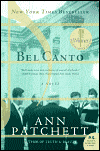
Bel Canto by Ann Patchett

This was the Bookclub book for May over at The Book Bitches. I finished it a little late because I was listening to it, and because I am catching the train to work these days and reading books, I no longer get through the audiobooks I have anywhere near as quickly!


Somewhere in South America, at the home of the country's vice president, a lavish birthday party is being held in honor of Mr. Hosokawa, a powerful Japanese businessman. Roxanne Coss, opera's most revered soprano, has mesmerized the international guests with her singing. It is a perfect evening -- until a band of gun-wielding terrorists breaks in through the air-conditioning vents and takes the entire party hostage. But what begins as a panicked, life-threatening scenario slowly evolves into something quite different, as terrorists and hostages forge unexpected bonds and people from different countries and continents become compatriots.
Without the demands of the world to shape their days, life on the inside becomes more beautiful than anything they had ever known before. At once riveting and impassioned, the narrative becomes a moving exploration of how people communicate when music is the only common language. Friendship, compassion, and the chance for great love lead the characters to forget the real danger that has been set in motion and cannot be stopped.


You know...the blurb on this one tells enough to make it interesting!

The main characters in this novel are Roxanne Coss (the opera singer), Mister Hosakawa (the opera fan), Gen (his interpreter) and Carmen (one of the terrorists), however there are several other characters that take a turn in the spotlight.

Whilst the pace of this book is ponderous at times, the writing is beautiful, and you can feel the book moving to an inevitably crashing crescendo. The hostage situation has been ongoing for many months, and whilst for the people within the compound that life has settled into a pleasant routine with music and football as part of the life they have become accustomed to, as far as the world outside is concerned the situation cannot continue.

If there was one thing that I didn't like it was the Epilogue, which certainly tied up a couple of loose ends, but in a way that was almost against the flow of the relationships that happened throughout the rest of the book.

If you are looking for a book to meander through, then this could be one for you!

Rating 3.5/5
TEMPLATE CREATED BY PRETTYWILDTHINGS