Showing posts with label Time Travel. Show all posts

Thursday, May 28, 2026

Gate to Kagoshima by Poppy Kuroki


A little while ago Laura from Laura's Reviews shared a review of Passage to Tokyo by Poppy Kuroki which is the second book in the Ancestor Memories series. I was sufficiently intrigued by the premise that I knew I wanted to read the books, but I had to start with the first book. That was both because I prefer to read series in order but also become of how gorgeous that cover is!

Isla McKenzie may have a Scottish accent and red hair but she has always been attracted to Japanese history and culture, thanks to her Japanese grandfather and ancestry. She travels to Japan with the hope of finding out whether her one of her ancestors was a Samurai as per family legend, through doing some research and visiting local Samurai sites. She travels to Kagoshima at the very south of Kyushu where the Satsuma Rebellion started and finished, effectively marking the end of the Samurai era in Japan in the late 1870s.

However, no one would have expected that being stuck in a temple during a severe thunderstorm could possibly lead to a journey back in time. Suddenly Isla finds herself in the historical city in the weeks leading up to what she knows will be the end. Found by two warriors, Isla is put under the charge of Keiichirō. As a foreigner, Isla is not trusted, especially given how strangely she is dressed and her lack of understanding of the world around her. 

Keiichirō comes from a family with a long history in the Samurai tradition. However, his family has fallen out of favour and so Kei is keen to do everything he can to please the Samurai leader. It doesn't really please his sister to have the foreigner in their home though.

Whilst the first half of the book really focusses on Isla and settling in to her new life, the second half of the book follows the rebellion with numerous brutal battles portrayed. Isla knows that it is not going to end well, and as her feelings for Kei grows she faces several agonising choices. How does she warn him of what is coming, will that change his decisions, and what will it mean for her if she can't get back to her own time. Does she even want to return to her own time, if she can?

I haven't read a lot of Japanese history, so this was really interesting to read. I think it was also a case of the right book at the right time as I enjoyed this! I am really looking forward to reading the second book, and hoping that there will be more books in the series!

 I am sharing this review with the Historical Fiction Reading Challenge which I host here and  the Speccy Fiction Challenge hosted at Book'd Out.

Rating 4/5

Saturday, January 29, 2022

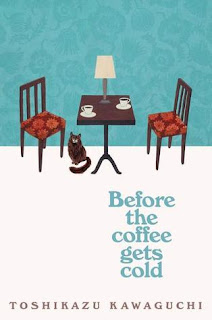
Weekend Cooking: Before the Coffee Gets Cold by Toshikazu Kawaguchi


If you were to ask me which is the place I would most like to visit in the world, the instant place that came to mind would be Paris. To be honest, I am not sure that would be that big of a surprise to anyone who has been reading my blog for any length of time. It is not, however, the only place I would love to visit, and this week I have been reading/listening to books set in two of those other places. I have been reading Still Life by Sarah Winman, set in Tuscany and I have been listening to Before the Coffee Gets Cold by Toshikazu Kawaguchi.


This book was mentioned in a Discord group I am in and I thought it sounded interesting but the main reason why I started listening to it is that it was a short audiobook at around 6 hours. I have a number of big books that I would like to listen to on audio but the idea of listening to a book that is 30 hours long when I have such little listening time is overwhelming,so this seemed like the perfect length.


Before the Coffee Gets Cold is set entirely within a basement cafe called Funiculi Funicula down an alleyway in Tokyo. Even in the heat of the summer, it remains cool. There are three clocks on the wall, each of which show a different time. The cafe is owned by married couple of Nagare and Kei ably assisted by Kazu, their regular customers come and go, and we get glimpses into small aspects of their lives.


There is something special about this cafe. You can time travel from the cafe but there are very strict rules. 


  • You must sit in a particular chair in the corner and the you can't move from the chair
  • You can only meet people who come into the cafe
  • Nothing that happens in the past will change the future
  • You must finish the coffee before it gets cold


It's not that it is as simple as just those four rules either. The particular chair is generally occupied by a ghost who sits quietly reading her book, so the only time you can sit in the chair are in the short moments when she takes a bathroom break. And if you break the other rules there are consequences.


There is an entire ritual associated with the time travel, performed by Kazu. There is a specific coffeepot that gets used, Kazu must be share that the traveller knows the rules, and the transition between times begins as soon as the coffee is poured.


The structure of the story is in effect four connected short stories where the time traveller has unfinished business. For one woman it is the chance to go back to have redo a conversation which happened just a few days ago with her now ex-boyfriend. For another it is the chance to have one last conversation with her sister that she has been deliberately avoiding for many years. Then, there is the nurse whose husband's memories are progressively fading away due to early onset Alzheimers and then finally a chance to say hello that would otherwise never happen.


There is no doubt that this book is a little on the sweet side, but it hit the spot for me this week. I was interested in the stories and characters, as well as the glimpses into Japanese culture that we were given. For example, in one of the stories, they talked about the Tanabata festival at Sendai, and it had me wishing that we would be able to visit. 


While there wasn't a lot of food specifically referenced in this book, but there was plenty of conversation around coffee and sake and the day to day running of the cafe. I am really looking forward to reading or listening to the next book. I would be particularly keen to find out what the deal with the ghost is. Hopefully we find out in the next book.


This book was translated by Geoffrey Tousselot and narrated by Arina II. I enjoyed the narration. I am curious that the second book has a different narrator so now I am not sure if I should jump straight into the next one or maybe listen to something else before going back to it. I do have several audiobooks that I am part way through so maybe I should finish some of those.


Rating 4/5


Weekly meals


Saturday - Dinner with Family
Sunday - Pizzas
Monday - Teriyaki beef bowls
Tuesday - 
Wednesday - Grilled cheese on toast
Thursday - Friday takeaway on Thursday
Friday - Honey chicken rice and broocoli


Weekend Cooking is open to anyone who has any kind of food-related post to share: Book reviews (novel, nonfiction), cookbook reviews, movie reviews, recipes, random thoughts, gadgets, quotations, photographs, restaurant reviews, travel information, or fun food facts. If your post is even vaguely foodie, feel free to grab the button and link up anytime over the weekend. You do not have to post on the weekend. Please link to your specific post, not your blog's home page

Tuesday, November 06, 2012

The Doomsday Book by Connie Willis

Yesterday at around this time, I was supposed to post the first half of a joint review of The Doomsday Book which I read with Aarti. Unfortunately it is now a day late because of some internet issues I suddenly had yesterday that required the purchase of a new modem. Sorry again Aarti!

Aarti's thoughts are in purple and mine are in black. You can read the second part (even though it has already been up there for a day) of the discussion over at Aarti's blog.


~~~~~~~~~~~~~~~~~~~~~~~~~~~~~~~~~


Marg: A couple of years ago now we read To Say Nothing of the Dog by Connie Willis and we both loved it! It has taken us more than two years to do so, but finally we have gotten around to reading The Doomsday Book which was actually the first book that Willis set in this world!

How did you find coming back to this world after so long? Did you slip straight back in or did it take you a little while to get used to it again.

 Aarti: It took me a little while to get used to it again. I think I was trying to understand the rules of time travel for the first bit and then just gave up. For example, I still have no idea how Kivrin was sent to the wrong year! I think I jumped straight back into the atmosphere, though - I could imagine the snow falling, all those bells tolling, the shoppers hurrying to get home, the university deserted for Christmas vacation, and later on, the terror people had about the possibility of another pandemic.

Marg: Yes, I never quite got my head around how she ended up in the wrong year.

If I was to pick just one word to describe this book it would be frantic. In both the present and the past there was such a feeling of impending disaster as both people at both ends of history tried to work out what was going on and would they be able to figure out how to save their people.

Aarti: Oh, yes! I felt like we just kept getting peeks into a very complicated scenarios and were left in the dark about everything else. It was strange because the “present” in the book was so frantic and stressful, whereas the past seemed so quiet, without much action at all.

I admit I thought that the plague would have showed up a lot earlier in the book. It only really came more than halfway through. I guess I can see why, as Kivrin’s entries became somewhat repetitive at that point, just about the exhausting work of having to care for other people. I didn’t expect so much build-up to the action. What did you think of that?


Marg: I had been warned that this was very much a plague book so I kept on waiting for it to turn up in the pages. I initially thought that Kivrin had caught it very early on so when it finally did show up, I guess I wasn’t surprised. There was a lot of caring for the other characters, and I was moved when some of the characters died but there were others where it was more an afterthought reaction - oh, so and so finally died.

Let‘s talk about the characters. I loved the character of Colin. I couldn’t remember any of the characters from this book appeared in TSNOTD but I do know that they are in BlackOut and All Clear and I can’t wait to see him again.

Aarti: I really had fun with Colin, too! He had such a hilarious vocabulary :-) I don’t know if any of these characters appeared in TSNOTD, either - no memory of them!

I had trouble feeling connected to the characters in the 14th century. It wasn’t that there were too many, it was just that they didn’t seem to have much personality. Kivrin seemed so isolated from everyone except Agnes and the priest. They were all so absorbed in their own problems and I didn’t get to know them at all. In contrast, I thought I knew the people in the present much better. Colin, for example, had a great force of personality. I also understood better the relationships between the characters in the present. They had history together, and interacted much more often than those in the past. Did you have a similar reaction or a very different one?


Marg: Definitely! I think part of the reason that we didn’t feel connected to any of them is that Kivrin was trying to live up to her created persona rather than be herself and therefore she was always on edge trying to ensure that she didn’t say or do the wrong thing and behave in a way that would be inappropriate for a young woman in that time.

Aarti: Very true - that probably had something to do with it. I just got the impression that Kivrin hardly ever TALKED to anyone except Agnes. So even when the plague hit and people started dying, I felt completely distanced from the action and didn’t even really know who was

Now click here to read the second part of the discussion.

Synopsis

Kivrin knows everything about the Middle Ages - she's read all the books. She knows it's dangerous: cutthroats in the woods, witch hunts, cholera, and millions dying in the plague. For a young historian, it's fascinating.

When Kivrin's tutors in Oxford's history lab finally agree to send her on an on-site study trip, she jumps at the chance to observe medieval life first-hand. But a crisis that strangely links the past and future leaves her stranded in the most deadly and terrifying era in human history, face to face with the heart-rending reality behind the statistics. And while she fights for her own life, Kivrin finds she has become and unlikely angel of hope in this dark time.

This book also fulfills the "something you would carry in your purse/handbag" category for the What's in a Name challenge as I always carry at least one doom book around in my handbag!


Thursday, July 28, 2011

The Rose Garden by Susanna Kearsley

When Eva’s filmstar sister Katrina dies, she leaves California and returns to Trelowarth, Cornwall , where they spent their childhood summers, to scatter Katrina’s ashes and in doing so return her to the place where she belongs. But Eva must also confront the ghosts from her own past, as well as those from a time long before her own. For the house where she so often stayed as a child is home not only to her old friends the Halletts, but also to the people who had lived there in the eighteenth century. When Eva finally accepts that she is able to slip between centuries and see and talk to the inhabitants from hundreds of years ago, she soon finds herself falling for Daniel Butler, a man who lived – and died – long before she herself was born. Eva begins to question her place in the present, and in laying her sister to rest, comes to realise that she too must decide where she really belongs, choosing between the life she knows and the past she feels so drawn towards

Today, Kelly from The Written World and I are doing a joint review of The Rose Garden by Susanna Kearsley! Head over to Kelly's blog to read the first half (be warned it is a bit gushy!)

Kelly's thoughts are in black and mine are in purple.

~~~~~~~~~~~~~~~~~~~~~~~

Yes, talking about the actual story is probably a good idea. The story starts off on a very negative note when Eva loses her sister, but the book becomes about much more than that. It is obvious why Eva is so connected to Cornwall. It was just the place that she is meant to be. She goes through a lot while she is there. The Hallett son was Katrina’s first love and even though many years have gone by and she married someone else, he is still battling with the emotions that her death evokes. His father has died and he is tending the family gardens, but he hates the public side of things and is resistant to much change. His sister, though, has big ideas and Eva helps her discover them by advertising the tea house that she has built. That tea house is so much more to the story, though... The reason it came to be in the first place was a touching story.

Given that you have read other books by Kearsley what did you think when Eva started hearing voices?

I wasn’t really surprised because I knew there was something of that nature to expect, but it was just a matter of finding out what method she was going to choose. That didn’t mean there were not a lot surprises in store, though!

So, the hearing voices is the first clue that all is not as it seems, which becomes even more obvious when Eva finds herself in the same house, but that it is occupied by different people in a different time. The house is occupied by a widower, Daniel Butler and his friend Fergal. They are men with a secret of their own - secret Jacobite supporters. The local constabulary, especially Constable Creed, is deeply  suspicious of the Butlers and an unexplained woman appearing could make things awkward, especially as she is sometimes there and sometimes isn’t, and she can’t really talk due to her obvious accent and different use of language. Also add into the mix a bit of smuggling and the charismatic and vivid brother Jack and life becomes very complicated all round.

First of all, I loved the characters you mentioned. I know, I am getting off track, but I can’t help pointing out how well written they all were! From the very beginning I loved Daniel. The very first scene was entertaining and I enjoyed watching him develop as a character each time she ‘magically’ appeared. I believe that he really brought the early setting to life by being so realistic. I could picture him and everything that was going on around him. I also love Fergal. Sometimes I think he was simply there to lighten the mood from time to time, but then Jack appeared and took that to a whole different level. Jack is interesting to say the least! In many ways the opposite of his brother, but he grew on me with time. Then, there was the very well-written villain, Constable Creed. I have to admit that I was not there, I was just reading about it, but every time the ‘law’ paid them a visit he creeped me out. It made the story dark just having him there and you never knew what was going to happen, but you felt like it was going to be bad. I cannot applaud Kearsley enough for writing such excellent characterizations. It is why I enjoy her books so much - coupled with the fact she writes fascinating story-lines, captures the time period very well, and has settings that I always want to visit!

Oh yes, the law man was totally, totally creepy!

One other aspect that I did find interesting was the fact that when Eva travelled through time, the treatment of the clothing aspects seemed very logical. I loved that she kept on having to hide the 18th century clothes (including Daniel’s dressing gown) in the future. It also tied in to her worries about changing things in the past.

I appreciated the fashion in general. That was another thing that was explained very well. I can just imagine how hard it is to go from the fashion of today to the fashion of the 18th-century. It was the same in Outlander by Diana Gabaldon. In this book the two men knew that she had no idea what she was doing so they aided her, but I found the description illuminating because it is not something I generally think about. The clothes themselves worked well to tie in other things, as well. One of the dresses that she brings back to the modern world belong to Daniel’s deceased wife, so using this one dress we learn more about Daniel and his past that might not have come up right away.

So wrapping up now, Kearsley has once again done a stellar job of making time slip seem like a completely probable possibility, has delivered a lushly romantic story, and this time also made us both gasp out loud with a fabulous twist in the tale!

I know! I have been writing this review and thinking ‘I want to read this again...’ I also want to reread her other books all of a sudden! It has brought the story back and reminded me just how much I loved this book, which I had not entirely forgotten, of course. I am so happy that you, and a few other people, lead me to read her because for the longest time I didn’t think she was my type of writer. I was wrong!

I could do with rereading as well, but I have lent the book to my non reader sister, who just read her first Kearsley and enjoyed it.

Ever since I first read The Winter Sea I have been encouraging everyone (not just you!) I know to read Susanna Kearsley. This book has reinforced that desire even more! So, if you haven’t read Kearsley, what are you waiting for?

Friday, September 10, 2010

To Say Nothing of the Dog by Connie Willis - Part 2

Ned is suffering disorientation, maudlin sentimentality and a tendency to become distracted by irrelevancies: classic symptoms of excessive time travel. And no wonder. Oxford's history department has just pulled him out of World War II and Ned's barely had time to wash off the gunpowder when he has a straw boater shoved on his head, a carpetbag in his hand and is thrown straight into Victorian England. For a holiday. But an impossible accident makes it hard to relax. Ned's holiday becomes a mad struggle to put together a historical jigsaw puzzle involving a cat, a diary, young lovers and the mysterious bishop's bird stump. If he can't make all the pieces fit it could mean the end of history itself. To Say Nothing of the Dog is a delightful and intriguing mystery spanning almost two centuries.


A couple of days ago Aarti from Booklust posted the discussion we had about the first half of To Say Nothing of the Dog. This second part of the discussion took place after we had both finished reading the book.

Aarti's thoughts are in green, and mine are in black.

We hope you enjoy our discussion.

****************

I thought we could start this part of the discussion talking about genre. By it’s very nature this book seems to be cross-genre to me. I have seen it referred to as sci-fi, there’s lots of historical references to Victorian times, to the battle of Waterloo, WWII, there’s humour and there is mystery. Do you think that the book fits into any one genre?

I think this is one of those books that I wish people didn’t place in a particular genre, because I just know that many people will skim a general outline of this book, think, “Oh, this is science fiction/historical fiction/humor/romance/fantasy. That’s not for me.” And then they’ll probably never look into this book again. I think it’s placed in fantasy/science fiction sections because of the time travel, which I don’t think is fair. Jasper Fforde has a similar premise (kind of) and is placed in general fiction, so why not this book by Willis? I guess I’d classify it as science fiction due to the time travel, but also historical fiction and satire. I don’t really care how it’s classified, really- it’s fun, and I don’t think potential readers should allow its genre to turn them away. If you read 20 pages of this book and are not hooked, then you can give up on it- but until then... I think it should be on your wish list!

I have every intention of reading both Black Out and All Clear (when it comes out later this year). We also mentioned briefly about the Doomsday Book in our discussion of the first half of the book, and how we weren’t sure about it given the doom title and the subject matter being the Plague. Having now read one of Willis’s time travel books do you feel any differently about reading that book?.

DEFINITELY! Those both are on my wish list as well as Doomsday Book. I think I will try to read Doomsday Book now as after reading the Amazon page on it, it looks like there is quite a bit of humor in it and I think I’d enjoy it.

From what I can tell there is at least one character that crosses over between both The Doomsday Book and To Say Nothing of the Dog. I was reorganising the bookshelves the other day and found my copy of The Doomsday Book. It is now sitting on my “to be read very soon” shelf.

One of the things that I loved in this book was all the little details. At one point found myself googling penwipers just to find out what on earth it was that Ned was looking at all these jumble sales!

I did the same thing for bird stump! Once I saw a picture of one, I understood immediately what it was, but I wish I could see this particular one as it sounds fabulously Victorian, as though excess vomited all over a tree and created the horror of the bishop’s bird stump.

It did sound particularly unattractive didn’t it, especially considering the fact that everyone was going to such lengths to try and locate it!

One of the things I really liked about this book was the idea of inevitability. Does what we do really matter, in the grand scheme of things? If something is supposed to happen, it will happen. And it was interesting to see how the main character struggled with the concept of free will, even as he was spending countless hours trying to lead people from generations before onto the life paths history said they went down (not sure if that makes any sense as a sentence, but hopefully you understand what I mean). So while some people consider time travel fascinating because of all the things you can change, all these characters were struggling like crazy to keep things exactly the same so as not to alter history too much. I thought the whole idea of fate and consequences tied up so well, and I found it particularly fitting that it was centered around WWII and the idea that people were forgetting about the war and its impact and the importance of monuments. I loved that entire theme. What did you think of it- the idea that the universe leads you down a particular path through all sorts of small coincidences?

In my life I have often had examples of where something is going to be the right thing to do, then the doors will open, whereas if it isn’t necessarily right then those doors will be getting slammed in your face. Very often, I have found myself in one situation, which then led to another, which in turn led to another, so I do think that a series of small incidents (rather than coincidences) can change your direction in life.

Yes, I got what you meant by that sentence, and I do like your train of thought there. Ned in particular was trying so hard to manipulate events so that what he thought had already happened did in fact happen. At the end of the novel though, I had a bit of an a-ha moment, when I realised that the anomaly that they were trying so hard to correct was actually not what the story was about at all. There was a whole other storyline going on. So clever!

Other random question I wanted to ask you- what do you think the Pandemic was? How many people do you think died, and how do you think it affected the world? I know there were only glancing references to it, but I find it interesting (and terrifying) that so much of sci fi refers to some sort of great outbreak of disease in which the population is decimated and the civilizations that come afterward are substantially changed from what came before.

I did wonder about the only glancing references to the Pandemic. At the time of reading it I wondered if it was something similar to the great flu epidemics, but I have a feeling that it was something much worse than that. It was interesting that there was so little focus on those events. I think it would be much more common for authors to dwell on those kind of events but maybe it wouldn’t have been the right tone for this book. I don’t think the author wanted to lose sight of the fact that this is supposed to be a fun book!


We mentioned in the first half that there should be a term for characters without speaking roles. Another thing that I loved was the books within the book - is there a term for that? I loved all the references to other novels, and by the end of it I realised that I really have to read the Lord Peter Wimsey novels. I had heard of them before, but I hadn’t been all that fussed about reading them. I think I need to change that. Were there any books that were referenced that you want to read as a result?

I have read one of the Lord Peter novels, but not the one that came up so often. It makes me want to read those, too! Especially the ones that involve Harriet Vane. I thought the whole storyline around those two was adorable and hilarious. I am sure Connie Willis must be a massive Sayers fan.

This is one of those books that I can see myself rereading in a couple of years, and finding new aspects to enjoy. I don’t do a lot of rereading normally, but every now and again I do come across a book that I think will benefit from a second, and subsequent, read through.

I hope to do a read-through of this one again, too, but maybe not in a couple of years. I actually hope to eventually read it again in tandem with someone else who maybe is reading it for the first time- it would be fun to read the funny parts out loud with someone.

I am so glad that I got to read this book after it had been sitting on my shelf unread for several years. I really should have read it earlier, although if I had of we wouldn’t have been able to do this discussion! The right time must have been now!

It was fate ;-)

Monday, June 21, 2010

A Cottage by the Sea by Ciji Ware

One woman, one man, one fate for both...

A remote cottage on the wild coast of Cornwall sounded to Blythe Barton Stowe like the perfect escape from the pain and humiliation of events in far off Hollywood that had ended her marriage, her career, and all but destroyed her self-esteem. But soon she seems to be reliving a centuries-old tragedy, and the handsome owner of the shabby manor house on the hill appears vitally entwined in her destiny. As they unearth one shocking family secret after another, Blythe is forced to conclude that her intriguing neighbour is more than just an impecunious British gentleman bent on saving his ancestral home. And the impeccably honourable Lucas Teague begins to see Blythe as a lifeline in an otherwise bleak existence.
But is the unbridled attraction they're experiencing a dangerous distraction, or could it be strong enough to transcend the insurmountable complexities of time and place...?


I have been thinking a lot about time travel and time slip novels lately, mainly because there are some novels that I love that fall into this category. There are certain locations that seem to be prime settings for this kind of novel. I am not sure if it is due to a mystical reputation, the weather, or a rich historical setting, or what it is exactly but places like Ireland, Scotland and Cornwall seem to foster the kind of environment which is perfect for timeslip novels in particular.

In this case, the setting is Cornwall, although the story starts in Hollywood. Blythe Barton is one half of a successful Hollywood partnership. She was the production designer, her British husband Christopher was a seriously hot producer who has just won an Oscar and together they made critically and popularly successful movies. That is until he betrays her in one of the most callous ways possible.

When the book opens, Blythe and Christopher are finalising their divorce in a sea of paparazzi and publicity. All Blythe wants to do is escape. She could have gone back home to Wyoming but it no longer feels home to her after the death of her grandmother. Instead she rents an isolated cottage on cliff overlooking the sea in Cornwall. She had always intended to research the possibility that her own family originally came from the area, but hadn't seem to have been time before now.

Her landlord  is handsome Lucas Teague, owner of the nearby stately home, Barton Hall. He is somewhat the impoverished landed gentry. Maybe impoverished is a little strong, but he is trying to come up with a way of saving his house as he is finding it difficult to keep up to date with taxes and with keeping the place maintained. He is therefore very pleased to have a paying tenant, especially when Blythe decides to extend the lease for the whole summer. When she comes up with a plan to turn the estate into a nursery business, the two of them go into partnership. Their attraction is mutual, but both of them carry a lot of emotional baggage with them, not to mention that there are the added complictions of Lucas's son and a very attractive godmother who seems to be more than just a friend.

Normally when I read a timeslip novel it is the historical story which keeps me most interested, but in this book I was more interested in the current story. The main reason for this is that I find the historical stuff a little too contrived... a little too try hard in some ways.

Whilst looking at the family tree in Lucas's home, she finds that there is an ancestor who bears her name who was also married to a Christopher. She is all the more surprised when she suddenly finds herself back in time seeing the events through the first Blythe's eyes. Where modern Blythe has been betrayed by those closest to her, historical Blythe is very much the betrayer. She is the betrothed of Christopher (known as Kit). It is a marriage that has been engineered by his father to ensure that the two land holdings that are adjacent to each other can be joined together both for future generations, but also because it will enable the much easier undertaking of smuggling operations. She is however in love (or at least lust) with Kit's much more charismatic and handsome younger brother.

I suspect the historical Blythe is meant to be seen as a spirited young woman who does whatever she can to get her own way, even if that means disgracing herself in the name of love, but in some ways she comes off instead as quite selfish. She certainly doesn't have the ability to be able to discern which of the people who surround her truly care for her. When the younger brother is sent into exile due to their terrible behaviour, Blythe thinks that she has the upper hand with her husband and that she will be able to keep her family home, but Kit has gone from a man who cherishes his wife to one who seeks the ultimate revenge.

I did like that through witnessing the events of the past, modern Blythe was able to get some perspective and healing from her own troubles, particularly when her ex husband turns up unexpectedly with a hidden agenda.

For the most part I enjoyed this read. Certainly I enjoyed the first few chapters enough to have requested the other book that my library has by this author before I had even finished the book. Normally I don't request the next book until I have finished the one that I was reading. By the time I got to the end, there were however a couple of things that didn't quite work for me.

The first thing I found a little odd was that the flashbacks weren't chronological. I guess there is no rule that says that they have to be, but if they weren't going to be then I wanted a reason why they weren't. Maybe I just didn't see that. The second actually related to the attempts at explanations that were given. As I mentioned before, places like Cornwall seem to me to have an aura of other worldliness so I didn't necessarily need to have the author work so hard at trying to bring a logical explanation of events. Some explanation was necessary for sure, but there were a few patches in the book where we were treated to long winded discussions which seemed to be a chance to regurgitate what the author had learned.

The final misstep for me was when the author was trying to make the connections between historical Blythe and modern Blythe's family, particularly in moving the action away from Cornwall which for me was so central to the success of the whole timeslip occurences.

This book was originally released in the late 1990s and so had been reviewed and updated, presumably with references to new technologies, and I thought that was pretty well done.

I really enjoyed all the references to Daphne du Maurier's books scattered throughout the pages, and I found myself wanting to pick up some of her books after I finished this one. It might still happen soon.

I guess to summarise, I enjoyed this one, but for different reasons than I would normally enjoy a time slip/time travel novel.

Thanks to Sourcebooks for sending me a review copy of this book.

Rating 4/5

Thursday, February 25, 2010

Alphabet in Historical Fiction: F is for French

Not F for French as in someone from France, but F for French, as in Jackie French, who is a very prolific Australian YA author! She writes all sorts of novels, including some adult novels, YA historical fiction, straight YA novels, non fiction and picture books. And that adds up to good news for me as I work my way slowly through at least some of her backlist!

I am going to post about my impressions of The Night They Stormed Eureka by Jackie French.


Here is the book blurb:


It's 1854 and, on the Ballarat goldfields, men are willing to risk their lives to find freedom and make their fortunes in the mine.

Sam, a homeless teenager, is called back to the past to join the Puddlehams, who run 'the best little cook shop on the diggings'. The Puddlehams dream of buying a hotel with velvet seats, while others dream of freedom from the government with its corrupt officials and brutal soldiers.

As the summer days get hotter, and the miners' protests are ignored with catastrophic results, Sam experiences first-hand the power of a united stand, which will change her life forever.

Jackie French's fresh look at an event entrenched in our nation heritage will touch and surprise every reader.

First an introduction. I had heard of Jackie French, but must confess that I often would get her confused with an Australian actress called Jackie Weaver. Last year, I participated in Book Smugglers YA Appreciation month, and asked for recommendations for YA historical fiction, and for YA by Australian authors. It must have been while I was visiting other participants that I discovered that Jackie French who met both criteria, and so I had to request a book from the library catalogue by her!

What I didn't realise when I first requested the book, is that this was actually a time travel novel. When we first meet Sam, she is a very unhappy, lonely teenage runaway. She is hiding in the cemetery and finds herself curled up on a gravestone of a couple called the Puddlehams. When she wakes up, she finds herself in a very different time and place - the Victorian Goldfields during the 1850s.

The goldfields are no place for a young girl, and Sam soon finds herself pretending to be a boy, and being taken under the wing of Mr and Mrs Puddleham. Mr Puddleham used to be a butler for Queen Victoria before he followed Mrs Puddleham to Australia. They quickly realised that they wouldn't make their fortune by panning for gold, but rather that they could make enough money to follow their dreams by running a cookshop on the diggings, or rather, the best cookshop on the diggings.

Sam is soon drafted in to help in the cookshop, and soon begins to make friends - not only with the Puddlehams, but also with the eccentric former professor, and a local half-caste boy. She finds it difficult to equate some of the things that happen to her friends with her 21st century experience.

The goldfields were a very volatile place with corruption and violence rife, and with tensions rising, it was only a matter of time before there would be trouble. Sam knows what tragedy is coming, and she hopes to keep those that she loves from being caught up. With the principles of freedom and justice at stake though, it is difficult and Sam finds herself at the encampment as the time approaches for the confrontation between the miners and the authorities.

The Eureka Stockade is one of the iconic events of Australian history. Whilst the actual stockade wasn't a success, the events that occurred there were the catalyst for change that helped build the foundations of Australian society particularly in terms of the right for non land owners to vote (just the men at this point). It was also where the Eureka flag was used for the first time as a banner to rally around. Even today, the Eureka flag is used by some of the trade unions as a symbol.

Whilst Sam brings us a bird's eye view of the events that lead up to the Eureka Stockade, she is also learning valuable life lessons like being able to ask for help when you need it, and about learning to love, and to accept love from others, but not without having to deal with sorrow along the way.

I definitely intend to read more from Jackie French. I am starting with a series about animals being present at major events in history. The first book in that series, The Goat Who Travelled the World is on my TBR pile to get to soon, and is about a goat that travels with the First Fleet to Australia (or New South Wales as it was known then).

Not only does this book qualify as my read for this letter in the Alphabet in Historical Fiction, it also qualifies as one of my reads for the Aussie Author Challenge, the Year of the Historical Challenge, and the Historical Fiction Reading Challenge.

Rating: 4/5

Monday, August 11, 2008

Legacy by Jeanette Baker

When a distant relative bequeaths a Scottish castle to Christina Murray, the beautiful college professor is off to a distant land to claim her inheritance. It is there that she meets Ian Douglas, a breathtakingly handsome man who may hold the key to the secrets of Traquair House...and to her heart. As Christina enters the elusive passageway to love, her all-too-lifelike dreams reveal that she is tied to three ghostly ancestors: Katrine, a spirited Jacobite in love with an Englishman...Jeanne, a Renaissance wife accused of witchcraft...and Mairi, the medieval maid who shares a forbidden passion with England's king.

Destined to become the curse's next victim, Christina travels through time to unveil the mystery of her family. But she soon discovers that her assumptions about Ian and their newly found love, as well as her own life, may have put her in grave danger...
I would never have chosen to pick up this book but when Jeanette Baker was chosen as Author of the Month over at Historical Romance Chat for May. When I say I would have have chosen to pick it up, it is not for any other reason than I had never ever heard of her before. When I checked the library catalogue under either name that she wrote under (Jeanette Baker and Jeanette Ramirez) this was the only one they had, so this is the book I chose to read.

The book opens with Christina Murray arriving at Traquair House in Scotland. She has no idea why she is there, and so she is totally surprised when it turns out that the historic house has been bequeathed to her by a complete stranger. Christina has just gone through a divorce from her husband of 15 years where one of the bigger issues is that she doesn't seem to be able to have children. So when the handsome neighbour, Ian Douglas, starts paying attention she is somewhat surprised, and very flattered by the attention.

Not long after arriving at Traquair, Christina starts to suffer strange headaches, and very strange dream where she finds herself in the past. At first she thinks that it might be something to do with her diabetes, but gradually it becomes that there is something more to it than that. Where first it feels like they are dreams gradually the intensity of the experiences increases until Christina is actually there feeling what the other three women who are her ancestors are feeling, seeing what they are seeing and hearing what they are hearing and with whom she shares several characteristics, including their looks and the fact that they all suffer from diabetes.

The first story to be told is that of Katrine Murray who lives in the mid 1700's. She is a spirited young lass (as are all of the ancestors). When she meets a handsome English soldier and fall in love it is impossible for her to know what the consequences will be. With the Jacobite rebellion gaining momentum, Katrine finds herself on the wrong side of the conflict. She is a Scottish woman living in England but when she returns to Scotland her heart is with her husband who is fighting for the English.

The second story is of Jeanne, who despite a rocky start, falls desperately in love with John Douglas. John has spent time in the English court, but he has now returned to the court of King James, known to his friend as Jamie. With a confrontation looming against the English, Jeanne has a vision of what is to come and tries to stop it with tragic consequences for her and her family.

The third story, and the one where the curse against the Douglas women started, goes back to the late 1200s when Mairi of Shields falls passionately in love with a man who turns up asking for hospitality at her home, and who she ends up nursing back to health. The man does not reveal his true identity, but when she goes to the English court, the truth is revealed. Her love is none other than King Edward I. As yet another conflict looms with the English, Mairi does what needs to be done and removes the Stone of Scone, used for centuries in the coronation ceremonies of Scottish kings and queens. When she marries against his wishes, their feelings change to hostility, once again with tragic consequences.

In effect there are four different love stories in this book. The fact three of them are doomed adds a level of poignancy. This is a really clever book in many ways. The only problem I had was with the contemporary sections. For the most part it is good, but just at the end, the resolution didn't quite work for me, both in terms of how Christina was going to get a happily ever after and break the curse, and also in how that HEA came about. Having said that, this is one of the more unusual books that I have read and I really did enjoy it.

I can't remember the last time I read a time travel book. It's been a while, but this one certainly has renewed my interest in the subgenre.

Coincidentally this morning I stumbled over a link to the Traquair House website over at Classical Bookworm, where you can read the history of the house, and see some pictures. It was really interesting to look at since I only finished this book in the early hours of this morning.

Saturday, October 06, 2007

Hundreds of Years to Reform a Rake by Laurie Brown

She's the only one who can help him

Deverell Thornton, the ninth Earl of Waite, must convince her to come back to his time and foil the plot that would destroy him...

His plea is irresistible


Josie Drummond is a modern career woman, and she doesn't believe time travel is possible, until her overpowering attraction conquers all doubt...


But what will happen when their time runs out?

As a modern woman, thrust back in time to the sparkling social whirlwind of the Regency period, Josephine Drummond must contend with the complex manners and mores of the day, make sure no one discovers her real identity and unmask a dangerous charlatan. And in the end, she must choose between the ghost who captivated her or the man himself, who is clearly determined to sweep her off her feet and shows no mercy when it comes to seduction...


Josie Drummond is a paranormal investigator (not a ghostbuster thank you!) who has been engaged by Lady Amelia to try and prove the existence of a ghost in her ancestral home. The sad fact is that said home is falling down around her ears, and Lady Amelia needs this evidence to be able to try and set up the castle as a themed bed and breakfast and to try and save her home. Of course, Amelia already knows full well that there is a ghost in the castle. He arrives for tea every Thursday at 3pm for tea. It is only as Josie is about to confirm that there is no evidence to suggest that the castle is haunted that Deverell manifests himself to her!

Deverell is a man with a plan. He is going to assist Amelia by transporting Josie back in time to help him expose a fraudulent fortune teller who managed to take most of the family fortune from his mother by holding seances to try and ascertain where the legendary missing family emeralds are.

Of course, a modern career woman would stick out like a sore thumb in the highly regimented world of the Regency ton, and so once Josie agrees to the plan (as ridiculous as the plan is) she is given a crash course in Regency etiquette, in dancing and dining. Never believing that Deverell's time travel plan will work, she suddenly finds herself thrust into a Regency house party. And there is one big distraction. Whilst Josie finds the ghost of Deverell attractive, there is a positive spark between the man Lord Deverell and her. Can she fend off unwelcome suitors who are determined to marry her for her fictional fortune, stop Deverell from being killed in a duel, uncover the charlatans and help to find the missing family jewels??

I did find the education of Josie to be very informative. In so many Regency set books there is mention of the rules, but many of them are just alluded to, so it was fascinating to see the author setting out some of those many rules in a straight forward way.

I have to confess that at first I did struggle to get into this book. I have been reading it for about a week, which is quite slow for me, but I think that had a lot to do with the fact that I have had a lot of distractions over the last couple of weeks or so. Once I sat down with the intention of just reading I was completely drawn into the story, and managed to read the last half of the book in one sitting.

Dev is charming, and definitely rakish, and Josie is a lot of fun. As a modern woman, she is a very good match for Dev. She is happy to banter with him, and to him must have seemed very liberated!

Reading this did make me wonder why don't I read more time travel books? I loved Karen Marie Moning's time travels, and I loved the Outlander series, and yet, I don't seem to recall reading many others! I do have at least one on my bookshelf. Somehow I must try to fit it into the reading schedule!

This book is the first book to be released from Sourcebooks new Casablanca romance line (which is going to include rereleases of some Georgette Heyer novels), and if this is a sign of things to come, then it will be worthwhile keeping an eye out for the books that are released as part of this line. Thanks to Sourcebooks for sending me this book to review!

Rating 4/5

Wednesday, November 08, 2006

Dragonswan by Sherrilyn Kenyon

The third instalment in the Dark Hunter series after Fantasy Lover and The Beginning.


Praised for novels that are "fun, sexy, wild, and fantastically different from anything else" (Romance Readers at Heart), New York Times bestselling author Sherrilyn Kenyon now delivers a special collector's-edition tale of unexpected passion woven from the mysteries of a celebrated ancient tapestry.

Beautiful scholar Channon MacRea has spent years studying the legendary Dragon Tapestry, devoting days and nights to deciphering the impenetrable Old English symbolism. Then one evening the unnaturally handsome Sebastian appears. He claims to hold the key to solving the tapestry's mysteries. Bearing magnificently taut and tanned flesh marked by intriguing scars of battle, he also claims to be a dragon slayer trapped between two worlds.

For Channon there's only one way to finally uncover the secrets of the intricate embroidery-by following the seductive stranger into a fantastic alternate world of magic, danger, and erotic adventure.

This is a rereleased novella, similar in fashion to one I reviewed not long ago by Karen Marie Moning called Into the Dreaming. In fact, both of these stories were originally in the same anthology called Tapestry that also featured novellas by Lynn Kurland and Madeline Hunter. Maybe I should see if their stories have also been rereleased so that I can say I have read the whole anthology!

Channon has been studying the legendary Dragon Tapestry for years, and one night she is studying it when Sebastian appears. His intention is to take the tapestry, as it is required to be the ransom to save his brother's life. He does have a few hours before he has to return to his own time, and so he spends it basically seducing Channon, who is portrayed as a somewhat scatterbrained academic. However just as he is about to leave Channon behind, he finds out that the Fates have decided that she is his one and only true mate. For his people, they have one shot and one shot only at love. If he leaves Channon behind he will never love again, but he can't take her against her will.

What follows is Channon's dream come true! She gets to spend time in a true medieval village, as she is taken back in time, but Sebastian still needs to protect her from his enemies.

This story was just okay for me. I had read a story about an inner beast that wants the girl not too long ago (JR Ward's Lover Eternal). I think I just need to get into the series proper.

One other comment to make though - it does tend to throw me out of a story when the author puts the couple into anatomically impossible sexual positions. I mean, in this book, the only way I could see one of the positions working was if she had three legs...and there was no mention anywhere else in the book to suggest that that was the case! If I have to think about how the position would work, chances are I am not that immersed in the book.

Rating: 2.5/5

Sunday, October 29, 2006

Into the Dreaming by Karen Marie Moning


Aspiring romance novelist Jane Sillee was completely in love with her fantasy man - the hot and strapping dark-haired Highlander who'd been coming to her in her dreams for years and inspired her sensual flights of literary fancy.

But it was more than her imagination that conjured up the brilliantly woven tapestry sporting the spitting image of her magnificently arrogant warrior. It was more than a dream that transported her to medieval Scotland to break an evil spell. And it was more than she could handle when she found herself wrapped in the muscular arms of Aeden MacKinnon, who had his won fantasies to fulfill.

This novella was originally published in the Tapestry anthology that also featured Lynn Kurland, Sherrilyn Kenyon and Madeline Hunter. It was recently rereleased as a kind of standalone novella and at only about 100 pages long it is a very quick read. I'm not really sure what I think of the format, and I'm not sure that I have seen too many others around in this format. As someone who came a bit later to this author, it is good to be able to easily locate this story that means that I have read most of what have been published. Just waiting for her latest, Darkfever, to come in at the library. Can't wait!!

As the first piece of writing that KMM had published, you can definitely see the bare bones of what became her really successful Highlander books. There is time travel, hot men in kilts, feisty virgin heroine, and the fae are there as well.

Well worth reading if you are a KMM fan!

Rating 4/5

Monday, July 03, 2006

Household Gods by Judith Tarr and Harry Turtledove

Nicole Gunther-Perrin is a modern young professional, proud of her legal skills but weary of childcare, of senior law partners who put the moves on her, and of her deadbeat ex-husband. Following a ghastly day of dealing with all three, she falls into bed asleep...and awakens the next morning to find herself in a different life, that of a widowed tavernkeeper in the Roman frontier town of Carnuntum around 170 A.D.

Delighted at first to be away from corrupt, sexist modern America, she quickly begins to realize that her new world is a complicated as her old one. Violence, dirt, and pain are everywhere - and yet many of the people she comes to know are as happy as those she knew in twentieth-century Los Angeles. Slavery is commonplace, gladiators kill for sport, and drunkenness is taken for granted - but everyday people somehow manage to face life with humor and good will.

No quitter, Nicole manages to adapt to her new life despite endless worry about the fate of her children "back" in the twentieth century. Then plague sweeps through Carnuntum, followed by brutal war. Amid pain and loss on a level she had never imagined, Nicole finds strength she had never known.


Having never read either of these two authors before, I came to this book without any preconceptions about the characters, the story, or anything like that. I was attracted to reading a story about finding yourself in a different time and place, and given that I tend to read historical fiction based in England, Ancient Rome was certainly a fresh focus for me.

Firstly, what did I like about this book? Reading about the life of an ordinary Roman woman was very interesting, along with many very interesting little tit bits, like the fact that many of the Roman statues were actually painted in very gaudy (and not necessarily tasteful) colours. The description of the smells and sounds of a busy Roman town were very vivid, as were the descriptions of the hardships that Nicole faced as she lived her life in the body of Umma, tavern keeper.

So, if those were the things that I did like, what didn't I like? Well, unfortunately, I didn't really ever warm to Nicole. During the first part of the book when she was in Los Angeles, I wanted to slap her, and say "Look, you aren't the only single mum out there trying to deal with all these issues". Then, when she got to Carnumtum, I wanted to slap her even more, if that's possible. The 20th century Nicole was pretty uptight a lot of the time, and she took that to the nth degree in 2nd century life. Her father had been an alcoholic and so she had never had a drink in her life, so when her slave Julia presents her with a cup of wine she thinks nothing of pushing it away and drinking water, and making "her" two children, also drink it, meaning that they all got sick. She was constantly making reference to the lead in the water pipes, in the makeup, and hygiene conditions in the town. Now, if someone was to really end up at that point of time, I am sure that they would be appalled by the conditions in the same way as Nicole was, but it felt as though I was being hit over the head over cricket bat over and over and over again with all the mentions of those types of issues.

It was interesting to watch as Nicole got to know all of the people that the previous Umma already knew, including her family, her slave Julia, her children and her boyfriend.

I guess for me the fact that I couldn't get to like Nicole all that much is a really big problem for this, so my rating reflects the fact that whilst I did like quite a lot about this book, there was one major flaw. Another less major flaw was that we found out what happened to Nicole's body while she was in the past, but there was never any mention at all about what happened to Umma whilst Nicole was being her. It would also have been interesting to watch Umma try to work out exactly what Nicole had done whilst she was Umma - like inexplicably being able to read Latin, and then when they were returned to their normal states, the fact that Umma once again wouldn't be able to read, and most particularly Umma's thoughts when she realised that Nicole had freed her slave.

One interesting thing, if you google for Carnumtum you can see images of the ruins of this actual Roman settlement which are located not too far from Vienna in Austria.

Rating 3/5

Friday, March 10, 2006

A Breath of Snow and Ashes by Diana Gabaldon

The sixth book in the Outlander series by Diana Gabaldon continues the story of the Fraser's and MacKenzies with all the action taking place in pre-revolution America.

The eagerly awaited new epic from the International Bestselling Author of The Fiery Cross Their love has survived time, but can they survive fate? 1772 - the eve of the American revolution. In Boston, men lie dead in the street and in the backwoods of America, isolated cabins burn in the darkness of the forest. The Colony is in ferment. Jamie Fraser, a passionate leader of men, receives an envoy from the Governor Josiah Martin, asking for help. The Governor needs someone to unite the backcountry, pacify the seething resentments of the settlers, and keep the mountains safe for King and Crown. Jamie Fraser, everyone agrees, is the man for the job. But Jamie knows what is to come. His wife, Claire, has travelled back in time from the twentieth century, and she knows that it's only a matter of a few years before the start of the War of Independence, ending with the exile or death of the men loyal to the King of England. Neither prospect appeals to Jamie. Beyond everything else, though, looms the threat of a tiny clipping from The Wilmington Gazette, dated 1776, which reports the destruction of the house on Fraser's Ridge, and the death by fire of James Fraser and all his family. Jamie hopes Claire is wrong, for once, about the future - but only time will tell.

When you read one of these books there are certain elements that appear to be necessary:

Rape

Abduction

Accusations of treason

Description of medical problems

Murder

Sex

Suggestions of witchcraft

I hope that doesn't sound too cynical, but I am afraid I was a little disheartened whilst reading this book. I went out and bought it the first day I saw it, and paid full price for it, not caring that if I had of waited two days I could have had it at a much reduced price. I settled down thinking that this would be the same as the others in the series in that I would be able to devour it in three days, having let an entire weekend pass me by while I spent time in 18th century Scotland and/or America. Six months later I have just finished listening to it in the car.

The good bits in this book, and there were plenty, were as always exceptional. The passages where Ian tells what happened to him when he spent time with the Cherokee were excellent and had me crying my eyes out as I travelled down the road at peak hour, as did several other sections of the book, including the parts that occurred after July 4, 1776. There were also numerous moments throughout the book when I gasped in shock, or laughed out loud, or was left wondering where on earth the journey was going to take me next.

As I was reading though, I couldn't help but feel that there were a lot of story arcs that didn't really need to be in the book to take the story forward. However, having now finished reading the book I can see how some of those parts actually did fit in with the ending, but it took me a long time to see it! There were also numerous occasions where I was far enough outside of the story to notice that phrases were repeated in quite rapid succession, and to be wondering what on earth this part had to do with anything!! I guess what I am saying is that the book could have done with harsher editing.

We still get to see plenty of the very lovely Jamie Fraser (....huge SIGH!!), but his son-in-law Roger Mackenzie comes into his own in this book, seemingly having found his place in the order of life on Fraser's Ridge. Jamie's young nephew Ian Murray is one of my other favourite characters and I really hope that in the next book we get to see him happy and settled (and yes, I am looking forward to the next book already!). Claire was Claire, and Brianna was much more likeable in this book, with wee Jemmy and Germaine in particular scene stealing merrily throughout the book.

I feel I must spare a word for Davina Porter, the actress who narrates the unabridged version of the Outlander books. She is amazing, with clear distinctions of voice between so many characters, and so easy to listen to. It is not always the case with narrators on audiobooks.

I do LOVE the earlier books in this series, and I will continue to buy them, but maybe I will wait a couple of days rather than buying the first copy I see of the next book. Many of the lingering questions of the series have been answered in this book, but I still look forward to reading more about how Claire and Jamie fair during the American Revolution, and hopefully beyond.

In summary, there were still many parts of trademark excellence from the author, but there were too parts of this book that either needed to be edited out or treated differently to keep my attention as the earlier books in the series had.

Rating 4/5

Saturday, January 14, 2006

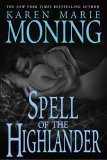
Spell of the Highlander by Karen Marie Moning


For me Spell of the Highlander by Karen Marie Moning was a welcome return to form. I have read all of her books and love Kiss of the Highlander and then The Dark Highlander. When I read The Immortal Highlander a little while ago I wasn't quite so impressed and was thinking that maybe I had read enough Monings. However I borrowed Spell from the library and was really glad that I did so! It hasn't replaced Kiss as my favourite, but it was a darn site better than The Immortal Highlander in my opinion.

Cian MacKeltar was one of the most powerful Druids of his time..only problem is his time was in the 9th Century. As a result of his enormous ego in relation to his powers he ends up being tricked into a situation which results in him being trapped inside of one of the great Unseelie relics, The Dark Glass for the last 1100 years. The Dark Glass offers immortality to the holder, as long as the tithe of pure gold is paid every 100 years at Samhain.

Jessica St James is an archeology student who is struggling to make ends meet. One of the ways she does this is to assist her professor. One night her professor asks her to make sure that a crate is received safely. What she doesn't know is that the crate has The Dark Glass in it. It is something of a surprise when she sees Cian, preserved 9th century alpha male, looking back at her through the glass.

There are however quite a few people who want to get hold of the treasure, not least of all Lucan Trevayne, the man who captured, and kept Cian in his cell for hundreds of years. Lucan has managed to track the glass down, and now Jessi is in mortal danger. Cian needs to get them somewhere safe and soon. After Cian gives Jessi the words to enable her to release him, at least temporarily, from his cell they are forced to go into hiding, until Cian can work out a way to protect them both for the next 20 days, as that is when the next tithe is due to be paid. If Lucan is not able to pay the tithe, then Cian's imprisonment will be over. One of Cian's most useful powers is The Voice, which enables him to ensure that people will do exactly as he says which enables them to get hotel rooms, flights and provisions.

The only problem for Cian and Jessi is that whilst Cian can be released at least every day they do not know how long he will be free before he simply disappears back into the mirror. This leads to several comical scenes such as when he disappears as they are grocery shopping.

Cian is alpha male through and through, but still very likeable, and willing to do anything to protect Jessi. Jessi is probably one of the more likeable heroines that the author has written. Whilst she is a struggling student working two jobs to get by, she is not an orphan, and she does maintain family ties, something that was missing with a couple of the more recent heroines.

Overall, this was a very enjoyable read, and there was enough room left over at the end of the book to show loyal readers that there will be more books in this series.

Rating 4 out of 5

Tuesday, December 13, 2005

The Immortal Highlander by Karen Marie Moning


Adam Black is back, but to say that things aren't all that great for him is a bit of an understatement. He meddled one too many times in human affairs and has managed to incur the wrath of Queen Aoibheal, Queen of the Tuatha de Danaan also known as the Fae. As punishment, the Queen has made him human, but unfortunately he is invisible to humans, or at least he thinks he is until he is sitting on a bench in Cincinnati and sees Gabrielle O'Callaghan watching him.

Gabrielle is the last in a line of Sidhe-seers - people who have always been able to see the fae. She is also a lonely and broke student, studying to become a lawyer whilst maintaining a job as an intern in a less than stellar law firm.

Adam Black has made appearances in previous books by Karen Marie Moning, where he has been portrayed as quite a negative presence, but in this book we meet the real Adam Black. He willingly admits that he is no angel, but he does live by his own code of conduct. Amongst his standards include rules that he will never force a woman to come to him, and he is loyal to the Queen.

Adam needs to contact the Queen to get her to reverse his state back to that of fae, but first he needs to escape from ruthless enemies who would love to kill Adam whilst he is in his human state. After meeting Gabrielle, Adam begins a slow and steady seduction, wining and dining her as only Adam Black knows how. Eventually though, it becomes a frantic race across time and place to get to where Adam can gain the attention of the Queen and save her from betrayal by those closest to her.

I have read all of Karen Marie Moning's books before this, and really enjoyed them. In fact I would go so far as to say that she was my first autobuy romance author, although I do still wait for the books to come out in paperback before I buy them. I also enjoyed this one, but not as much as I have some of the others, in particular Kiss of the Highlander and The Dark Highlander. Having said that, I actually preferred Gabrielle as a heroine, particularly to Gwen. She was smart and relatively grounded for a woman who sees fae wherever she goes.

However, after all the anticipation to read Adam's story, it was ultimately not as satisfying as I wanted it to be. I couldn't quite put my finger on what it was, but I think maybe the idea of Adam just taking whatever he wanted, whenever he needed it kind of irritated me...How many pairs of designer leather trousers does one man need after all..and also that there seemed to be a lot of information about the fae and sidhe-seers. Whilst this information was interesting and may even have been necessary, it isn't what keeps me engrossed in a story. Whatever it was, it meant that I wasn't fully engaged in the story, to the point that I actually had time to wonder about things like the mechanics of the sexual shenanigans and does anyone really look that great in leather trousers?

It was great to catch up with Drustan and Gwen, and Dageus and Chloe who play a pivotal role in this book, and to find out what they have been up to since we last met them.

Overall this wasn't the best book I've read from the author, although it was still enjoyable. I have already put a request in for the newest Highlander book by her, called Spell of the Highlander, so hopefully that won't take too long to come in at the library!

Rating 3.5/5
TEMPLATE CREATED BY PRETTYWILDTHINGS